Most of us have heard that cortisol is the stress hormone and the goal is to lower it. Dr. Erin Kinney says that is backwards. Cortisol is your body’s energy currency. It gets you out of bed, handles stress, and helps your body heal. The real problem is running out.
At 22, Erin was a marathon runner who gained thirty pounds almost overnight, couldn’t get out of bed, and cried all the time. Labs showed her cortisol was nearly nonexistent. That sent her to naturopathic medicine and, years later, to her Cortisol Bank Account framework: everything you do is a withdrawal, rest is a deposit, and healing only happens when you earn more than you spend.
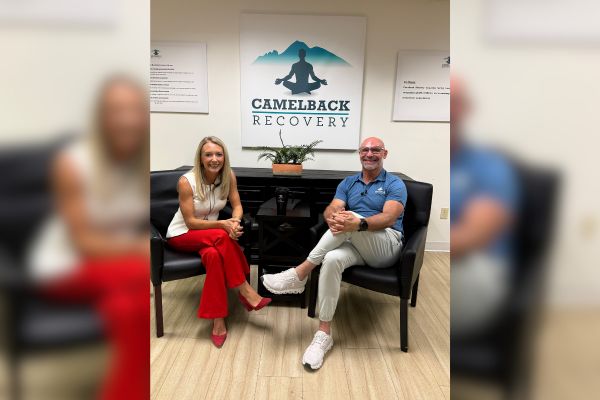
Recorded live in front of clients and staff at Camelback Recovery’s outpatient treatment center in Phoenix, Arizona.
What we get into:
- why cortisol is not the enemy
- the stress muscle and the relax muscle
- why Tim wakes up at 2 AM
- what alcohol and drugs do to your cortisol bank account
- why anxiety and depression often rise in early sobriety
- swapping drugs and alcohol for exercise, social media, or gambling
- caffeine as a credit card
- the earliest signs of burnout
- cortisol, hormones, and women in recovery
- why people feel exhausted even when they’re doing everything right
- the ten minute “toes up”
- what a day that supports cortisol looks like
- when to get labs
- audience questions on nicotine, chronic pain, thyroid and autoimmunity, and whether remembering hard times stresses the body
- a live exercise with an imaginary lemon; and
- Erin’s own story of burning out again in 2021 and how she got better.
—
Watch the episode here
Listen to the podcast here
Restoring Your Vitality With The Cortisol Cure
Dr. Erin Kinney Says Cortisol Is Not The Stress Hormone You’ve Been Told To Fear. It Is Your Body’s Energy Currency, And Most People In Recovery Are Overdrawn
Understanding The Cortisol Cure And The Energy Bank Account
Welcome back to the show. Our guest is someone whose work speaks to almost everyone in this room. Many of us know what it feels like to run on empty, to be wired and tired, to do everything right and still feel exhausted. Dr. Erin Kinney is a naturopathic doctor, a mom of five, and a stress expert known as the stress reset expert. She is the founder of The Kinney Clinic and author of The Cortisol Cure, where she teaches her cortisol bank account framework as a simple way to understand why we burn out and how to rebuild our energy. She has helped more than 7,000 patients and clients get out of survival mode and feel like themselves again. Whether you are here for alcohol, drugs, anxiety, or depression, this conversation is for you.
—
Dr. Erin, welcome to the show.
Thanks so much for having me, Tim. Thanks for being here, guys.
I’m grateful to have you, and Melissa Manabadi connected us. I have done some research on you, and I am really excited to have this conversation to talk about cortisol because cortisol obviously affects all of us. I got my own cortisol issues so I am excited to, selfishly, I get to ask you some questions. What inspired you to be so passionate about cortisol, and what inspired you to write The Cortisol Cure? Was there a moment in your own life when you realized that you were running on empty?
In my early 20s, I was maybe 22. I graduated from undergrad and went from this happy healthy I was a marathon runner to a happy healthy 20 something and I In what felt like overnight gained 30 pounds could not get out of bed. I was so tired, crying all the time. I felt terrible. This went on for a few months and finally my friends and family said “You need to go see somebody. You need to go to a doctor.
I went to my GP, and before I could even finish telling him all the symptoms, he wrote me a prescription for an antidepressant and waved me out the door. I left that appointment feeling dismissed and hopeless and like, “Wait, there has got to be something else going on.” I had also become a vegan during this time, and something felt very physically wrong in my body. I did not think an antidepressant was just going to fix everything. I was in therapy at the time, which was helpful. She ended up referring me to a naturopathic doctor.
This guy sat down with me for over two hours, asking me all these questions. I felt really seen. I felt really heard. He ran a whole panel of blood work. Looked at my nutrient levels and looked at my hormones. I was really depleted. I had been a vegan, and I had been running 50 plus miles a week for several years. I was low in iron, B12, like every nutrient. My cortisol levels were nearly non-existent. I was very confused. I thought, “Is not cortisol the bad, scary stress hormone? Do I not want it to be low?”
The doctor said, “No, cortisol is what gives you energy to handle stress. It keeps your brain locked in. Actually, it is the hormone that makes you feel alive and able to do things.” I had nearly none of it. That sparked my interest. I am like, “Wait a second.” I ended up at the time I was working my family business, which I was miserable in. I lived in the middle of nowhere in Delaware. I was working with these 65 year old white men and it was not really, it was not my jam. I ended up leaving my job, which was hard because I was working for my dad. There was a lot of emotional stuff there.
I went to work for a headhunter in DC. I was trying to have them find me a job, and they hired me to do headhunting. I was like, “This is cool. I like talking to people.” Six months into the job, my boss hits me down, and she is like, “This is not the job for you.” I was like, “What? I thought I was doing a great job.” She goes, “You keep bringing me resumes.” I would bring her a resume and be like, “Listen to this person there. She got Lyme disease, and she had to quit her job because of all these symptoms, or she was struggling with depression, and she had to do XYZ.”
She goes, “I do not really care about their medical conditions. I want to know if they can do the job or not.” She is like, “You clearly care.” I ended up leaving that job and decided I wanted to go back to being an atrophic doctor so I could help others like me. I was obsessed with cortisol. I have been doing this work for twenty-plus years. It was my own story that helped get me there.
Why We Need Cortisol For Energy And Healing
It is so interesting. It is like we want our cortisol levels to be low, but we also want them to be high at times.
You do not want them to be low. Cortisol, has everyone here heard of cortisol? We think of it as the stress hormone, but there is a little bit more nuance to that. It is the hormone your body makes in response to stress to give you energy to handle stress. You have to have it. Now, it is also what controls your circadian rhythm. Your question was slightly correct. You do want it to be at its highest in the morning, and then it slowly falls off throughout the day.
It should be at its lowest right before sleep. While you are sleeping, your cortisol actually will rise. I created this analogy or framework, if you will, that if we think of cortisol as being your body’s energy currency, because, number one, it gives you energy. Number two, cortisol is also a major anti-inflammatory. It reduces joint pain. It will get rid of migraines. It is your body’s natural prednisone. Everyone knows what prednisone is. Prednisone is what they give you when inflammation gets out of control. We want to have enough cortisol. Think of it as the thing your body spends to fix or heal things.
Anytime you do anything, and this is a really important thing to understand, it could be something you love or something you hate. For example, I love speaking to groups. I love talking about this topic, but I am currently spending my energy. Anytime you do anything, exercise, cold plunging is also an energy spend. I talked about that earlier. Hiking, and granted, these have other benefits, but driving in traffic, feeling emotional stress, those are all going to take this cortisol. Anytime you rest, do grounding, you do breath work, you sleep, you are engaging that parasympathetic nervous system, you pray, you meditate, you journal, these are all energy deposits or cortisol deposits.
Ideally, what we are wanting to do in the body is make sure we are earning just as much or a little bit more than you are spending. If we are spending more energy than you are earning, that is when symptoms start to show up in the body. I had this saying that is the through line of the book, is it healing, whether you are trying to heal depression, anxiety, or joint pain or migraines only occurs when you are earning more energy than you are spending. Again, we want to have cortisol. Cortisol is not something we want to lower and suppress. We want to be able to spend it when we need it. Does that make sense?
Yes. For example, again, selfishly, this is my question. I wake up every single night at 2:00. I am not able to go back to sleep. Last night was different, actually. I was able to sleep through the night. It was beautiful. It was amazing. A lot of times I find myself waking up at about 2:00, and I am up for 60 to 90 minutes before I am able to fall back asleep. My cortisol is increasing at the wrong time.
It is kicking in. It’s almost like jet lag.
It’s like it is time for me to wake up. Like, “No, it is not time for me to wake up.” I end up in bed for 8 hours, but I only get 6 hours of sleep. It is so frustrating.
In the book, there is a whole chapter on sleep. There are a couple of things that could be happening there. Your cortisol could be spiking early just because of dysregulated patterns. The other thing that can sometimes be a problem is blood sugar dysregulation. I do not know what your diet looks like throughout the day, but if blood sugar dips low. Let me back up. There are what I call external stressors and what I call internal stressors, both of which are energy spent. External stressors would be things like traffic, politics, work, kids, things happening outside your body. Internal stressors are things going on inside your body.
If your blood sugar dips too low because maybe you ate dinner really early or you did not eat enough protein or whatever it is, or you metabolize your sugar really quickly, that is an internal stressor. When we get a stressor, the body will be like, “I need some cortisol to handle the stress, because cortisol is one of its jobs is to keep blood sugar up. That would be something I always explore first with patients is let us make sure your blood sugar is staying really regulated. I do not know if you eat dinner early.
I do try to eat early. I like eating early.
Which is great, but sometimes you can wear what is called a CGM.
Yes. I have not worn one of those, and I am working with another. Do you know Sachin Patel?
Yes.
I just started working with Sachin.
I can give you really good insight because sometimes it is literally a blood sugar dip that wakes you up. There is another thing, so I am going to introduce another concept that I talk about a lot in the book and I think this is a really important concept for anyone in recovery or anyone really in our world is if we think about the nervous system. You have got the parasympathetic nervous system, which is the rest-and-digest system, and you have got your sympathetic, which is the fight-or-flight.
Building Your Relaxed Muscle To Overcome Burnout
I like to think of those as being like two muscles. You have got a stress muscle, and you have a relaxed muscle. If all you do all day long or for years, all you did was work out your stress muscle, that muscle gets very strong, which is fine. You want to have a strong stress muscle. If you have not worked out your relaxed muscles, that muscle gets weak. When you fall asleep at 10:00 or whatever, you sleep for a couple of hours. If that stress muscle is really strong, it will be like, “Wait, he has got things to do. I better wake him up.” Sometimes it is literally just a lingering effect of a nervous system that was running on overdrive for a while.
Cortisol Cure: If all you do all day long is work out your stress muscles, that muscle gets very strong. But if you haven’t worked out your relaxed muscles, that muscle gets weak.
It is just a strong stress muscle. The longer you put the reps in for your relaxed muscle we were talking about earlier, you are like, you are doing all these great activities. Think about if you are trying to build abs muscles and you have never built your abdominal muscles before, it is going to take six months to build a six-pack. You cannot expect to go to the gym 2 times, 4 times, 6 times and immediately get a really strong ab. You have to keep putting the reps in to make sure you train that relaxed muscle. Does that resonate?
Yes. I have a pretty strong stress muscle.
Listen, again, it is fine to have a strong stress muscle, but if you do not have the rest muscle to back it up, then that is the only muscle that is firing, and the body is like, “Wait.” It is essentially as if your nervous system is trying to protect you. It is like waking you up because it is like, there are things we have to take care of, and we have to teach it like, “No, you actually can calm down a little bit.”
Again, since I have been in recovery and as I am farther along my recovery path, it is like praying, meditating, gratitude, journaling. I spend more time relaxing. Even as of recently, I have realized that I probably should not exercise every single day.
Exercise is a major energy spend. It is great for us, but it will drain you. That was one of the things that drained me. I was a marathon runner. I really ran myself into the ground.
I was doing Ironman for a couple of years. Same thing.
Exactly. Again, if you have been operating with a strong stress muscle, working that muscle out feels comfortable to you. A lot of people, if you have had trauma and a lot of stress for several years or your whole life, working out like that feels normal to you.
The path of least resistance is to go back to doing what we are comfortable doing or what we know, even if it is not good for us.
Listen, I am not saying exercise is bad for you. To your point, taking a day or two off can actually be more beneficial for your health and for working out that relaxed muscle.
Especially as I get older.
As we get older, it takes a lot of energy, and it takes a lot of cofactors, B vitamins, iron, magnesium to build cortisol. As we get older, those nutrients, our absorption levels go down. We do need to rest more as we get older if we want to kind of operate the same.
Cortisol is often misunderstood. Why do you think it is missed, and you may have already answered this question?
It is misunderstood because when you are in a stress state, your cortisol levels will be on the higher side. Everyone’s like, “Cortisol is the problem.” It is really your body producing it because it is what helps you get the energy. The real major problem is when your cortisol bank account gets low, and you are still working out your stress muscle. You still have things to do. The body will say, “She’s here. She still needs energy. I do not have any cortisol, but let me upregulate the production of adrenaline.” Adrenaline is like when you have a lot of adrenaline.
It is like drinking fifteen Red Bulls after staying up all night, in which you will have that energy, but you are going to be wired and tired, and your heart’s racing, and I think cortisol often gets blamed for that. It is like all your cortisol is high. You cannot sleep tired but wired, but often adrenaline is one of the drivers of that. Here’s the other really important thing to note about cortisol. The body produces it in response to stress. Let us say we are all sitting in here and a lion jumps in here.
All of our brains are going to send a signal to our adrenals to pump out cortisol so that we can run and fight. Once we get safe from whatever the stressor is, that same cortisol actually goes back to a receptor in your brain, and it turns off further production of cortisol. You actually need cortisol to both handle the stress and to turn off the stress response. If you are running on empty, you are more likely to stay in that activated stress response. You have to have enough in that account to turn it on and turn it off.
Cortisol Cure: You actually need cortisol to both handle the stress and turn off the stress response. If you’re running on empty, you’re more likely to stay in that activated stress response.
We will talk about the cortisol bank account soon. First, social media is full of advice on cortisol. What do most people get wrong about cortisol and stress?
Everyone’s like, “Lower your cortisol. You have got to do this to lower your cortisol, get rid of it, suppress it, if you want it as low as possible.” It is not true. You do. You want it. You want to have it in the appropriate amounts at the right times. The good news is that a lot of the advice they are telling you to do on social media, grounding, walking, those things are helpful for building that cortisol account back up, kind of thing. There are a lot of supplements that people will market, like “This is going to lower your cortisol.” You do not want to take a supplement that is going to lower your cortisol. You will not feel good if you are someone who has been in a lot of stress for a long time.
Walk us through the cortisol bank account. What counts as a deposit? What counts as a withdrawal?
As we talked earlier, anytime you do anything, that is a withdrawal. That could be sitting in traffic. That could be scrolling on social media. That could be literally thinking about something you have going on tomorrow and worrying about it, or worrying about a conversation you had yesterday. Even worries or thoughts are going to be a waste of that account. Now here we want to really think about how do I make deposits is, sitting outside in the sun with your feet on the ground, or taking a walk in nature, or meditating, praying. All the things we have kind of touched on are really good practices.
In the beginning of my book, I have like 30 ideas, but ideally it is something where your brain is either calm or focused. One of my favorite things is doing a jigsaw puzzle because your body wants your body to be calm. Not spending energy and you want your brain to not be spinning out about something. I find it is nice to do puzzles again, something that keeps the brain occupied because that teaches the brain to calm down and the body to calm down. A lot of people think, I have to, I must get a massage, or I must do these big, long, stress management practices.
Really, the answer is what am I doing throughout the day? Maybe I can schedule three 10-minute sessions and put them on my calendar, and I am going to put my phone down, and I am going to take ten deep breaths before lunch. After lunch, I am going to lie flat and listen to three of my favorite songs. It is like a mini deposit. Think about if you ever put yourself on a budget. You are not going to cut out your mortgage. We do not usually cut out the bigger spends. Like, “Where are these little things that I can adjust?” That is what it is like, what can I do throughout the day to train that relaxed muscle and to make little deposits, because those little deposits will add up over time.
Understood. Lots of people in this room use alcohol or drugs to cope with stress, to get up in the morning, or to wind down at night. What does that do to the cortisol bank account?
How Alcohol And Unprocessed Emotions Drain Your Energy
Let us talk about alcohol first. Alcohol, a lot of people use it to chill out at the end of the day and calm the nervous system, or thinking they calm the nervous system down. Alcohol, one, is a major energy spent when you drink alcohol. I have another analogy. I like analogies a lot. I cannot tell. There are analogies where, if you pretend your body is like a house, inside your house you have a laundry room, a bathroom, a kitchen. Those are like your major organs.
Alcohol is like starting a fire in your kitchen. Every time you drink it, your body is going to use all its energy to detox the alcohol. It is a huge energy spend to get rid of it. One, you are draining your energy account just by drinking it. Two, alcohol will cause a blood sugar spike, and then a couple of hours later, your blood sugar will drop drastically. When that drops, that is going to also be a stressor, and it is going to require cortisol. If you spend a long time drinking alcohol, it will drain your account pretty quickly.
The other thing to think about, one of the big things I talk about in the book, is different disruptors that can affect sleep, energy, and mood. Keeping emotions stuck in is a really big one. It is a huge energy cost. If you have grief, anger, shame, whatever it is, and you are not processing it or moving it through the body, huge energy is spent. A lot of us, and I use, because we have all done this at times where we have an emotion we do not like to feel and we think, “I’ll use a substance to push the emotion away.”
We feel better in the moment, but that emotion never gets processed. It is still there. It is almost like if you use alcohol, any substance that shuts the nervous system down, but you did not do that work yourself. It is almost like having your mom write your term papers in high school. The stuff gets turned in, you go to sleep, but you never actually trained yourself how to do it. When you stop drinking, or you stop using something to suppress those emotions or suppress the anxiety, you do not have the ability to turn it off yourself. This is why we tend to see anxiety and depression and all these things rise when you first get sober. Who here experienced that? Everybody. You come off of something, and you are like, “All the surface.”
What I have experienced and what I have seen is that people move. There are drugs and alcohol, which are the solution, and then you stop drinking and doing drugs, and then next thing you know, you are moving to other things, whether it is social media, gambling, exercise, Ironman, like 100%. What does that do when you just use something else as the solution and you do not actually process the emotions?
All those things you mentioned are way better for the body than alcohol and drugs. That is a natural evolution. At the end of the day, if you are still not doing that work, it is still costing the body so much energy. Doing the emotional work, which is, listen, I am talking about it like it is easy. It is not easy work. We do not want to feel those things. I myself am a really good emotional suppressor. I have to schedule in, “I am going to talk to my therapist, I am going to schedule the time to journal, I am going to schedule the time to pray.” It is really important to do that, even though it does not feel good. It feels so much better once you get it out of you.
It feels better on the other side, like a cold plunge. You feel better on the other side.
The cold plunge actually is a major stressor to the body, but it is really good for training the nervous system. When you get out of the cold plunge, your body goes into this crazy, hormetic stress mode, and then you get out, and it helps you relax. If you are going to do a cold plunge, I recommend doing a meditation or something really relaxing afterwards so you can train the body to go. You want to be able to go into stress mode and then come out of it. If you are using the cold plunge in the right way, it is much better for men than it is for women. Again, training stressed women.
It is not supposed to be as cold.
If you are a cycling female, it is not good to do it the week before your period or during your period. Men get a little bit more benefit out of it.
How do you know if your quarter-salt bank account is depleted? What are the earliest signs of burnout?
Recognizing The Early Signs Of Burnout And Fatigue
Fatigue. Fatigue is the biggest one, like morning fatigue. You wake up in the morning, and even if you slept for a decent amount of time, and you are like, “I cannot function without caffeine.” That is a really important thing. You might say, “My energy is great, but you are drinking five Red Bulls.” Listen, I do not have a problem with caffeine. Caffeine, in this analogy, is like spending money on a credit card. If you have the money to pay it back, you are just earning points.
Great, no problem. If your bank account is overdrawn and all you do is keep swiping your credit card, the same thing goes for any upper drug, wise. If you are doing Adderall or anything that is going to give you false energy, it is actually like driving you further and further into debt. Caffeine, I usually recommend not ever drinking caffeine until you first see the sunlight, you have stepped outside, you have eaten some protein. It is a little bit better to wait till later in the day so that you can have your natural energy come up.
I got a little sidetracked. We have got low energy. Another big one is actually low mood or the lack of excitement, or just like, you are not going to get full-on depression like right when your bank account goes low. You just are kind of like nothing really interests you. You are like, “What is the point?” You have that kind of, “What is the point of getting up? What is the point of getting out of bed? I just feel like blah.” That is a really key sign that your body is struggling to make enough cortisol.
If you need coffee first thing in the morning.
If you cannot function without caffeine, that is a telltale sign that your cortisol bank account is low.
If you can't function without caffeine, that is a telltale sign that your cortisol bank account is low. Share on XThey say you should wait 90 minutes before you have your first cup of coffee.
Yes, if you can do that.
What happens to your cortisol when you have a cup of coffee first thing in the morning?
What is going to happen more is that if your cortisol is low, the caffeine is going to jolt you into a fight-or-flight state. If you do not have enough cortisol, you are going to get high adrenaline. The caffeine is going to do the same thing as alcohol. You will get a blood sugar spike and a blood sugar dip. That blood sugar dip is going to cost you even more cortisol. Actually, by the time you get to the afternoon, you are going to be even more drained, which then you are going to reach for more caffeine.
Your sleep may be dysregulated. You mentioned that when you were drinking energy drinks, you were not sleeping. Energy drinks will keep you in that crazy fight-or-flight mode all night long. It is best to always have caffeine with some protein. If you can wait 90 minutes, great. If you cannot, the way to start is to make sure you eat something before you have it, because that will keep your blood sugar more stable.
Do you think caffeine with protein, or caffeine with fat, like a Bulletproof coffee?
That is going to be a little bit better. This might be more individual to the person. If you struggle with blood sugar, the fat might not be enough. I find most people feel a lot better energy-wise the rest of the day when they do have some protein and fat with them. They can do Bulletproof coffee, but eat some food. Another big thing is that eating regular meals is so important. It is so simple, but that will keep your blood sugar stable, which will keep cortisol spend a little bit lower.
Remember, it is like you want your cortisol to be available for when you really need it. Just like you want a savings account to be available if you really need it. Another thing that will happen is that, over time, if your cortisol bank account is low, we have sex hormones, estrogen, progesterone, and testosterone, which are molecularly very similar to cortisol. They are like your savings accounts.
The body can be like, “I do not have cortisol, but there is some testosterone over there, and it will start stealing from those.” In women, this can start to show up as menstrual cycle dysregularities, really bad PMDD or PMS before the period, low infant men, low sex drive, low mood, poor muscle mass. It can start to really affect other aspects of the physiology if we keep running on empty, essentially. The body is like, I have to have something to give me energy.
Now, Sachin did a genetic test on me, and he said that I metabolize caffeine quickly or very well.
Good, that is great.
He said it is a drink-up.
Listen, it is how you feel. If you still drink caffeine and you can still fall asleep and your energy is good and you could survive a day without caffeine, then you are fine. You are just earning points.
Great. For women in this room, how are cortisol hormones and cycles connected, and what should women in recovery pay attention to?
Just what I was just mentioning, for women, if cortisol has been running on the lower side, we tend to see irregularities in their menstrual cycle because of what it does to the sex hormones. That could be longer cycles. Sometimes that can be skipped cycles. It could be really intense symptoms right before the period or around ovulation. Prioritize working out that rest muscle, particularly in the week before your period. For a lot of women, if you are someone who moved to exercise in recovery, I see women really overdoing it with exercise and then their periods get all wonky.
Balancing Hormones And Cycles For Women In Recovery
Working with your cycle. Sometimes you can eat with your cycle. Usually we see women feel better when they eat more carbs in that second half of the cycle, and they lower their exercise intensity. That can be really helpful. Listen, the female hormone cycle is very sensitive. It is very sensitive. Alcohol, drugs, caffeine, all these things are going to have an impact. Focusing on prioritizing rest and downtime really helps the cycles.
Why do so many people feel exhausted even when they are doing everything right?
It’s because they are doing everything. This is part of our culture. I do not think this is anyone inherently doing anything wrong. We always think that if we are going to get better, we must do more things. I must do the cold plunge, do the red light, do the thing, but at the end of the day, sometimes those things are great, but sometimes you just need to sit in the sun and stare at the wildlife. Sometimes being more is actually what we need. There are going to be different seasons of life. Recovery is obviously a really intense season.
In this season, there may be a couple of healthy things that you need to do. A lot of it is figuring out how to focus on being in a relaxed state. I also think that a lot of us do the diet, we do exercise, we do supplements, but we do not think about the emotional work. That gets missed even in functional medicine, where they are diving into all the things, doing all the specialty testing, but no one is really asking, “What emotion is in there that has not been processed yet?” I honestly think that has the biggest impact on health over anything else.
Yes, 100% emotional, mental, spiritual, physical. They are all connected. Do you know Wes Kress?
No.
He is a licensed acupuncturist, Master of Science in oriental medicine. I work with him, and I do the new fit. Do you know the newbie?
Yes.
I work with the new fit, but it is a therapy session that is like a physical workout combined with therapy. It is amazing. I see him every single week, and it is my favorite thing that I do. He is booked months in advance, so I just have, like, a recurring.
At the end of the day, there is so much on social media and in the news like, “Here you got to do this, and you got to do this to feel better, and this is what you need for your depression.” At the end of the day, you need to check in with yourself and be like, “Is this for me? Is this going to be depositing energy into my account, or is this going to be a spend for me?” If you are feeling like your account is overdrawn, we want to avoid the spends. We want to focus on what is going to be really giving me energy. That could be a healthy thing.
It could be a relationship. Sometimes I feel like I was just on Melissa, and I was recording on my show you are talking about. Your primary relationships, whether that is family members or romantic partners, if things are not feeling good there, we have got to make sure that we are spending time with people that fill us up. If there is a relationship that is really important and it is not feeling good, there needs to be work done there too. Which, again, is not easy work, but it is important.
It is like spending time with people that you want to be like. You are the average of the five people that you spend the most time with. I want to spend time with people who are living the life that I want to live and being a good example to me. That is what I aspire to be like. What is one change listeners can make to start making deposits back into their account?
My favorite recommendation that I recommend blanket to all my patients is one, make sure you are eating lunch. I see a lot of people skip lunch, but after lunch, it takes a minimum of ten minutes, and I call this taking a toe’s up. All you have to do is lie flat for ten minutes. If you want to listen to a meditation or pray silently, this would be no phone, no reading. It is like a little reset. It allows the blood pressure to calm down. It allows the heart rate to slow down. It kind of teaches the body, “I am okay to lie down in the middle. I am safe enough toliey down in the middle of the day for ten minutes.”
A lot of us have health practices that we do in the morning and the evening, which are fantastic. If you then finish those, whatever you are doing in the morning, and then you go all day, you are training that stress muscle to stay on. If you can pick a point in the middle of the day, you are like, “I am going to take a break in the middle of the day. I am going to put my feet up for ten minutes. I am going to chill out.” The first few times you do it, it might feel uncomfortable.
It might feel like a waste of time, and you might be like, “What was Dr. Kinney talking about? This is not doing anything.” The more you do it, you will be like, “This feels really nice. It is like plugging in your phone for ten minutes.” A lot in our culture, we are like, “I am tired. Let me push through. Let me drink caffeine. Let me go on a run.” Sometimes that helps, but if your energy account’s low and you spend more energy, is your account going to go up?
No. The better thing is, let me give in to it. If you are tired after lunch, which, listen, a lot of us are, let us givein too the fatigue. Let us plug in, let us recharge our energy a little bit. Maybe you go for a walk, or then you feel like there are some people who love what they call a caffeine power nap. You drink a tiny bit of caffeine, and then you sleep for twenty minutes. By the time you wake up, caffeine has kicked in.
I did that for a long time.
That could be really helpful for people.
Drink a cup of coffee. Set the clock for twenty minutes.
Every time you push through, energy-wise, and listen, there are times you have to do that. You are essentially training your system. It is not safe enough to be relaxed or calm. When you are tired, go lie down for 5 or 10 minutes and then come out of it. It is simple.
I like it, though. A lot of times we do not think of that. It has to become a habit. It has to be something that you actually think about.
A lot of the things that I talk about in the book are so simple. They are free. It does not necessarily always mean they are easy to put into practice. Lifestyle changes are not easy. You guys all know this. It is not easy to change your lifestyle, but it does take practice to make it a habit. You just have to be consistent with it. When you are, it really pays off.
Lifestyle changes are not easy. It's not easy to change your lifestyle, but it does take practice to make it a habit. You just have to be consistent with it. Share on XWhat does a day that supports cortisol look like from morning until evening?
Getting up in the morning, getting sunlight first thing, eating within 30 minutes, something with protein, maybe a little bit of movement, and eating again at lunch, taking some little break, eating dinner, and then having a nice wind-down evening in the routine. Obviously, in the middle of the day, you do your work, you do your things, but make sure there are like three points. Morning, noon, evening, where you are fueling yourself, and you are doing a little bit of resting.
Being aware and paying attention to your cortisol and just checking in, is that something that’s helpful?
Yes. It is your energy. Cortisol is going to give you energy. If your energy is low, your cortisol is probably low. It is supposed to be low at the end of the day. That is when it is supposed to be at its lowest so we can fall asleep. Just making sure, and then getting outside. You guys have beautiful weather here. It is easier for you anytime you step outside, take two deep breaths, look up at the sky, get some sunlight. That is a good refill for your account. Sometimes I think, not sometimes, when we set an intention to do this. Intentions are so powerful. You are like, “I am going to intentionally take a two-minute break.” Your body is going to feel it. You will get something out of it.
When should someone consider labs or working with a practitioner? What questions should they ask?
I honestly think anyone in recovery, because there could be so many issues that go on with neurotransmitters and nutrient deficiencies and all those things, that it is good to run some labs, some basic labs, especially like looking at your CBC, looking at your thyroid, looking at your basic nutrients. Those are things, like if you are low on B12 or you are low on iron or you are low on zinc, it is harder for the body to make the neurotransmitters like serotonin and dopamine and GABA that make you feel happy and connected and calm.
Again, if you do not have those building blocks, you cannot make those neurotransmitters. If anything, I would recommend getting some labs done and just looking at your nutrient levels. You can get your cortisol tested. It is a blood test. You can get it tested first thing in the morning. If you are struggling with mood stuff especially, it is a good idea to work with a provider. If you have kind of done all your likes, I am doing all these things. I have been doing them for a while. I feel like they are into my practice, and I still do not feel any better. That is when I would say work with someone who can dig a little deeper. What else do we have?
Opening Up To Guest Q&A On Stress And Recovery
Now is the time we want to open it up to questions. Here we go.
“I have a question about, like, nicotine. How does that affect cortisol levels?”
Nicotine is going to mostly affect your neurotransmitters. It is going to keep the brain locked in. It is more going to have an, it does not directly impact cortisol, but if you are smoking and you are then not hungry and you are not eating, it can dysregulate blood sugar. That can also affect. Listen, nicotine is something that is commonly used during recovery.
Something like, “I stopped that because it makes you feel better for an instant.” Thinking about it like we were talking about earlier, we use drugs and alcohol to suppress stuff, and now nicotine is like the next step. Looking at how you are using it is important too. Are you using it to kind of suppress how you are feeling or manage anxiety? Making sure you have other tools besides nicotine would be what I would recommend. Does that resonate?
“That makes sense because I know there are some studies that show that nicotine can be good, obviously not smoking it.”
It can actually help brain function. A lot of people would use nicotine plus what is blue? Methylene blue, and you can do the zins. Again, I think it is in how you are using it. If you are like, if you cannot focus without the nicotine, then having some other practices in there would be helpful. I would look at nicotine almost like I look at caffeine, like it can be a useful enhancement, but you have got to make sure the other things are laid down first.
“It does not directly affect hormones?”
Not that I know of. It is going to directly affect cortisol. If you are really sensitive and you are taking a lot of nicotine and it puts you in a really anxious state, that is going to be a depletion. If you are using a little bit of it, it is calming you down a little bit. It is not going to directly lower the cortisol. Good question.
“You were talking earlier about the stress muscle, and did you call it the peace muscle?”
The relax muscle.
“How do you work out the relax muscle, and what is that again?”
Activating Your Parasympathetic Nervous System
It is an analogy that I made up, but it is essentially your parasympathetic nervous system. We have got the two. You have got fight-or-flight, which your body goes into when you are doing stuff, and you are in stress mode. The parasympathetic is when the nervous system is relaxed. We also call it rest and digest. That is essentially when all the blood flow goes into your digestive organs, your heart, and your lungs. It is when the body goes into healing mode.
To work out your relaxed muscles, you just have to do something that is calming to your body. That could be meditation, it could be prayer, it could be reading a book, could be sitting and snuggling with a pet, could be making eye contact with a partner. Honestly, having sex is a nice way to work out the relaxed muscles. Anything that has your body calm and your brain either calm or focused on something, so it is not spinning out about an anxious thought. Does that make sense?
It could literally be like during my days when I am seeing patients. I have some days where I see a ton of patients, and in between each patient I do not have much time. I will go to the bathroom, and I have soap in my bathroom that I bought from my favorite spa. It smells like my spa. I will go in there, and I will wash my hands, and I hum because humming stimulates the vagus nerve. It calms the nervous system down. I will hum a couple of songs, and I smell the soap. I am literally in there for two minutes, but it is a little rep for my relaxed muscles.
Here’s the other thing, your brain does not know the difference between what it is thinking about and what is actually happening. This is where daydreaming can actually be a really nice rep for your relaxed muscles. If you are able to, like, lie flat and think about a favorite vacation or, honestly, a sexual fantasy or something where you feel calm, and you feel good, that is a really nice, relaxed rep too. Listen, you can do that anywhere. You can close your eyes in between meetings or in the car when you are sitting. Maybe not close your eyes in the car.

Cortisol Cure: Your brain doesn’t know the difference between what it’s thinking about and what’s actually happening.
It is a self-driving car.
If you are sitting in traffic and you know when it is going to. My point is, these do not have to be long things. They can be little mini practices. My aim with this book was to make stress management not feel so stressful. Sometimes we all know, “I am stressed, and it is affecting my health, but I do not know what to do about it.” I always make the comment when I am speaking about this book that I have five kids.
I have five, and they are 9 to 14. They are a lot. I run a clinic, and I am on this book tour, and those are my two biggest energy spends. My two biggest stressors, honestly. I love them. I am not going to get rid of them. I am not going to manage them. I just have to make sure I have enough in my account. Some days I do not have time to get an hour-long massage. I have got those two minutes in between patients to fill my account or to work out my relaxed muscles. Does that answer your question?
“Yes, definitely.”
“I do not think you mentioned it when you were speaking, but do know how I suffer from chronic pain, and how that affects cortisol, because that is like a stressful and exhausting situation to be in.”
Managing Chronic Pain And Its Toll On Your Cortisol
I am sorry you are struggling with that. Chronic pain is a really tough one. It is almost like there is a loop here. Being in chronic pain, or pain of any kind, is going to keep you stuck in a stress state. The body uses cortisol to reduce pain. The longer that you are in pain, you are essentially going to keep spending from that bank account constantly. Chronic pain can become this really tricky thing. Is it pain all over the body?
“Yes, I have arthritis in all of my joints and osteoarthritis.”
Joint pain can be really rough. I do not know if you are working with a provider or looking for some underlying issues because sometimes that can be helpful, but it is really important for you to be doing these, to try to fill your bank account whenever you can. There is a whole chapter in the book about pain, and if there are medications or things you can take to kind of help you get out of pain, I always recommend doing that during sleep because that is when your body does need some good, relaxed time. Do you have anything that works for your pain?
“A form of pain medication, but it does not solve all the problems. I have been managing this since I was two, so it has been a really long time.”
I am so sorry.
“No, it is okay. I have stuff to manage. It is just management, basically. It is not getting rid of it.”
Whenever you are taking pain medication, if it lowers it enough, or you are able to work on some of the relaxing things, we want to try to give the body what it needs to build as much cortisol as possible because cortisol is your body’s natural prednisone, like I said earlier. It does help reduce pain.
“When you said that, I was like, ‘Really?’”
Yes, it does. Usually, when someone’s in chronic pain, it means their cortisol, they do not have enough of it to kind of help manage all of that or mitigate it. I would recommend, whenever you are using the medication that’s helping you, to make sure you are doing something that’s calming to your body. When you are in chronic pain, it is like your stress muscle is getting worked out all the time. It can be really, really tricky.
Again, this is where testing for certain nutrient deficiencies or also looking at hormones comes in. I do not know if you have had those things checked, but sometimes estrogen levels being too low or progesterone levels being too low can make pain worse. I feel like in this current day and age, hormone replacement therapy has been life-saving for a lot of people with pain issues. I would encourage you to look into that thing if you have not already. You would probably really enjoy the book, and that pain chapter, I think, would be helpful for you.
“Thank you so much.”
You are welcome. Great question.
“Can you hear me all right?”
Yes.
“Good. I have Hashimoto’s hyperthyroidism, and back when they had to go to a naturopath, which actually saved my life back in the day because Western medicine was not testing for the right hormone at the time, and it kept telling me I was anemic. At that time, which would have been over a decade ago, I was put on like a cortisol manager and I have since, I have not taken it in at least like 7, or 8 years. As far as hypothyroidism and Hashimoto’s and the direct relationship to cortisol, are there any tips and tricks you could tell me about how I should be taking my medicine and everything?”
The Relationship Between Hashimoto’s And The Stress Response
Talk about Hashimoto’s because Hashimoto’s is an autoimmune disease. It is basically your immune system attacking your thyroid. When we stay stuck in a chronic fight-or-flight state, the sympathetic nervous system, the fight part of that will activate your immune system to attack things. If there is nothing foreign for the body to attack and you stay in that fight-or-flight state, the body will start attacking itself. All autoimmunity has some level of nervous system dysregulation.
Working on training that relaxed muscle, now listen, this is not going to reverse Hashimoto’s overnight, but it is the number one most important thing to do. I find in a lot of, I treat a lot of Hashimoto’s cases. In a lot of my Hashimoto’s patients, there has been a history of trauma, or actually, there is another fantastic book that came out this year. It is called Autoimmunity and Good Girls. I highly recommend you read that.
It just talks about how, for a lot of women, we take care of everybody else and we put our needs last, and we essentially train the body to not recognize ourselves. When you train the body to not recognize yourself, the immune system will not recognize itself, and it will start attacking itself. There is a huge emotional layer in there as well. You were asking specifically how cortisol impacts.
“Yes, and no, that is very helpful. I notice even if I just rest my eyes for like ten minutes, how big of a difference it makes in my day. Yes, also how I could get the best out of my medication. I have removed gluten from my diet, but things like that to manage my cortisol. Any tips on how I should be taking my medication?”
Usually, with thyroid, you take Synthroid? Levo and Lyo. I usually recommend taking it first thing in the morning, like they usually recommend. Sometimes people will take it later in the day. How do you take it, first thing?
“I do take it in the morning. My sister always tells me, I have a woman in my family who has hypo. My kids are blessed, but it is around like caffeine too. The biggest thing she has told me is not to have caffeine. “
It’s really important for thyroid patients not to have caffeine on their stomach. Essentially, blood sugar regulation is so important. Think about it like this. You have got four major players in your endocrine system. You have your sex hormones, your thyroid, and your cortisol. They are like this triangle. If any one of them goes up or down, it is going to affect the other one. The thing that holds it up, I am going to use your cup for a second, is your blood sugar.
If your blood sugar is staying stable and strong, it is a lot easier for the body to keep thyroid, cortisol, and the sex hormones in balance. If your blood sugar is going all over the place, the other hormones are going to do this. Eating regular meals, so simple, but really important. Another thing I like about Hashimoto’s is simple belly breathing. Hand on the belly, hand on the chest, breathe in, make a pregnant belly as big as you can.
There are a lot of women who suck their stomachs in, and they breathe up here, which is fight-or-flight breathing, which trains the stress muscle again. Keep taking your medication at the same time, and make sure you eat before you have caffeine. I would say three times a day, you should lie down for ten minutes and, like, put that on your calendar and make it a non-negotiable and read that auto. That book has changed how I have talked tonight with autoimmune patients.
“Yes, I wrote it down. Autoimmune and the good girls. Thank you so much. It is very helpful. ”
You are welcome.
“You mentioned that your brain does not know the difference between thoughts and, I guess, what is happening in real life. If I am thinking about previous stressful times, I guess maybe in times I have been drinking or using and stuff like that, does that revert my body back and flood it with certain neurochemicals?”
Training Your Brain To Break Free From Negative Loops
It can, yes. Listen, sometimes we do have to go back and go through those to kind of process things. I am not saying to never do that, but if you are in a loop, and this is where, like, has anyone here done EMDR? Where you are, like, retraining your thoughts about something can be really helpful. Trying to train the brain to think about good things. In your brain, listen, your brain is going to always try to go back and think about past traumas because it wants to learn from them and not make the same mistake. It is part of our biology to do that, but your brain is highly trainable.
If you can be like, for ten minutes a day, I am going to think about something that always makes me feel good, a vacation, my puppy, my partner, whatever it is, and try to get the brain to think about that good thing. Again, think about it, anytime you have a sexual fantasy, it is not actually happening. Sometimes you will actually get turned on. The brain thinks it is happening. There is an exercise you can do where you close your eyes. Actually, let us do this right now. This might be kind of fun. Everyone, close your eyes. I want you to imagine you are standing in your kitchen.
On the counter or table in your kitchen, there is a bowl of lemons. I want you to go walk over to this bowl of lemons. I want you to pick up one of the lemons. Hold the lemon in your hand. Feel how heavy it is. See the lemon. It is yellow. I want you to bring the lemon to your nose and take an inhale. You can smell a very faint lemon feeling. Now I want you to find your kitchen drawer that contains your knives.
Take out a knife. You can put the lemon on the counter. Go find a cutting board. Pick up a cutting board. Put that on the counter. Now I want you to cut the lemon in half. Be very careful. Do not cut your finger. Cut the lemon in half. I want you to take that half lemon, and I want you to bring it to your nose again. Now I want you to taste the lemon. Is anyone getting a salivation response where you feel like you are tasting a lemon just a little bit?
None of us smelled a lemon. This exercise usually made a little bit longer, but did anyone, you actually felt like a little bit of salivation. This is a simple activity that shows you, like, “Your brain thought you were in your kitchen cutting a lemon.” This is just to show you that your brain does think what you are thinking about is real. Does that answer your question?
“Yes. It probably increases cravings and stuff like that. I should snap myself out of it a little faster.”
More so, focusing on where I can start to think about something that makes me feel good. That does not. If you cannot find an experience in your recent life to think about, think about something that has not happened. A vacation is a nice thing to do, or, again, something that is easy for you to daydream about. We just want to start to train the brain that it actually feels good to think about things that feel good. Again, your brain is going to go back to those things, and that is okay, but the quicker you can flip it around, the less time you are going to be spending in that stressful state.
“Thank you.”
You are welcome. What else do we have? Anything else? Great questions, guys.
Is there anything I should have asked you that I did not ask you?
A Personal Journey Through Depression To Lasting Healing
I do not know if there is anything you should have asked me, but I was just going to share one other story from my life. In 2019, I got divorced, and just as I was picking up the pieces, the world shut down for COVID, and I was single parenting, and my business exploded overnight because everyone was at home with nothing to do and worried about their health. I ran a million miles an hour. I did not walk at all. I was not fueling myself. Was surviving on caffeine and sheer will. I was not sleeping. Right around the end of 2021, so about two years into this, I got into the deepest depression I have ever been in. I was suicidal. I never made a plan, but I did not want to be here anymore.
If I did not have my daughters, I probably would have made a plan. I would just wake up every morning. I would wake up, and I could not wait to go to bed. Listen, outwardly, have a great life. Yes, I had gotten divorced, but I had a great life. I have beautiful daughters, friends, and family. I was so ashamed because I was the person who was supposed to help people with this. I had been there before. I had run myself into the ground yet again. One of the other reasons I am so passionate about this work is because I know just how bad it can feel when you do not prioritize these basic, simple lifestyle practices.
I also know how good it can feel. I was actually my office manager at the time. I feel like I was sobbing. It was like a Tuesday morning, and I could not pull it together. I could not suppress the emotion any longer, and she sat me down, and she was like, “You have got to make a change.” She is like, “This is a disaster. We got it. You got to stay here so you can help people.” I went back into therapy. I started actually doing the practices that I taught people, and it took a while. It took probably two years. About two years after I started that work, I met the love of my life.
We got married last year and my life other than a new marriage, my life is not outwardly that different, but what is different is how I feel every day. I feel excited to do things. I want to wake up. I do not want to just go to bed. I actually want to be here and do my work and show up as my best self. I just want to share that, if you are feeling really low, you can get better. You can. It is not an overnight fix. These things. That is what it really is. We all want the Amazon Prime of health.
We want to get it tomorrow. Listen, if there was a pill we could all take. My dad read my book as one of the early readers, and he called me. He is like, “Great book. Is there a pill?” I was like, “You missed the point.” He was joking, but I was like, if there was a pill, we would all be taking it. I commend you guys for doing what you have all done. It is no easy journey to go through recovery. It is really not easy.
It is a journey.
It is slow, and it is a journey.
To your point. It is not that nothing happens overnight. It is just consistent work day after day, hour after hour, doing the next right thing, praying, meditating, learning, listening to people like you.
The next right thing. It is like Frozen 2. Sing that song. I have a lot of kids.
Now, did you say you have five girls?
I birthed two girls, and now I have three stepkids, two boys and a girl.
You said you have girls, and I know you have five.
No. Girls and two boys.
That is not a lot. We have two sisters, and I think that is a lot.
The female energy is a lot.
Is there anything we can help you with?
I do not know. If you guys want to read the book and share it, and if you do read the book and you like it, please message me or share it with me because I really like hearing how it is impacting people. I did not bring a copy. I meant to bring a copy, and I think I told you, I went to the Barnes & Noble, and they sold out of their copy.
I should have had a copy. I dropped the ball as well.
It is called The Cortisol Cure. It is bright, sunny, it is like pink and purple, the color and you can get it on Amazon.
My next question is how can people find you? Promote your book. How can people connect?
The Cortisol Cure, you can get it on Amazon and Target. It is available anywhere you would buy a book. There is also an audiobook that I read. You can get that on Audible. I hang out a lot on Instagram. I am @Dr.Kinney. I also have a podcast called The Dr. Kinney Show where I interview all kinds of cool people. My website is DrErinKinney.com. We also have, we launched this year, it is The Cortisol Cure Community. We do a live weekly call. I have tons of resources in there beyond the book. The call is a Q&A with me and usually a topic that we talk about. You can look into that on my website as well.
Awesome.
Thank you, guys, for having me.
Let us give it up for Dr. Kinney.
Thank you so much. Great.
Thank you.
Important Links
- Dr. Erin Kinney
- Dr. Erin Kinney on Instagram
- The Kinney Clinic
- The Cortisol Cure
- The Dr. Kinney Show
- The Cortisol Cure Community
About Dr. Erin Kinney
 Dr. Erin Kinney is a naturopathic doctor, speaker, podcast host, and author of The Cortisol Cure. Called the Stress Reset Expert, she helps stressed out patients balance their hormones, improve their mood, and restore their energy.
Her path started with her own crash. In her early twenties she was a marathon runner who suddenly gained weight, couldn’t get out of bed, and felt hopeless. A naturopathic doctor finally ran the labs that showed what was happening: depleted nutrients and cortisol levels that were nearly nonexistent. She went on to become a naturopathic doctor herself, and she has been focused on cortisol ever since.
She founded The Kinney Clinic and, according to her publisher, has helped more than 7,000 patients and clients. In The Cortisol Cure she introduces the Cortisol Bank Account: cortisol as the currency your body spends to create energy, handle stress, and heal, earned back through rest. She hosts The Dr. Kinney Show, leads the Cortisol Cure Community with a weekly live Q&A, and lives in Maryland with her husband and five children.