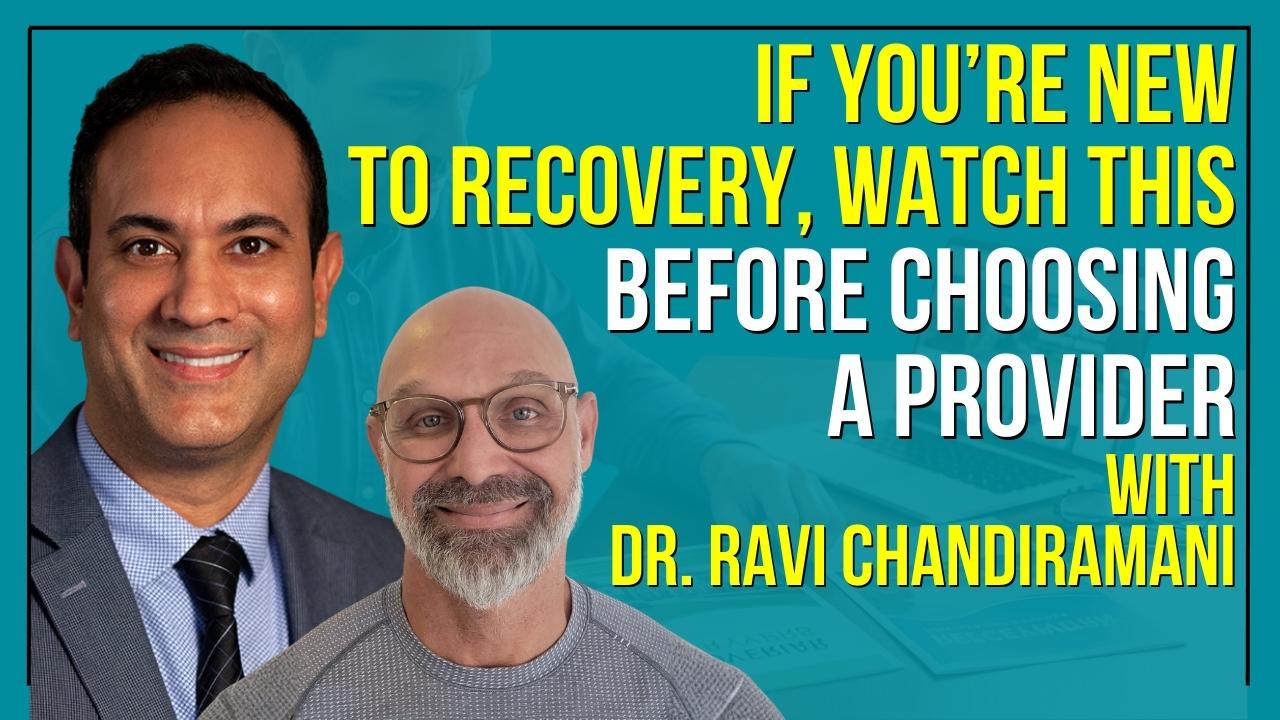
Choosing a medical provider in recovery can be a life-and-death decision, and for those newly sober, an uninformed choice could create a dangerous path back to old habits. Dr. Ravi Chandiramani, a pioneering naturopathic physician and expert in integrative addiction medicine with over 20 years of clinical experience, joins us to issue a crucial warning about the growing trend of biohacking, peptide therapy, and hormone replacement that is being pitched to vulnerable people in early recovery. Dr. Chandiramani explains the dangerous “more is better” mindset that makes controlled substances like testosterone and stimulants like Phentermine a slippery slope, detailing the real risks of non-FDA-approved peptides, and why it is essential to partner with a doctor who knows your full addiction history.
—
Watch the episode here
Listen to the podcast here
If You’re New To Recovery, Watch This Before Choosing A Provider With Dr. Ravi Chandiramani
The Addiction Doctor’s Major Concerns: Biohacking In Recovery
We’re talking about truth in healthcare, hormones in recovery, liver health and how to think critically about some of the most talked about treatments in wellness and the addiction space. I’m joined by Dr. Ravi Chandiramani, a naturopathic physician and pioneer in integrative addiction medicine with over many years of direct clinical experience working with substance use and co-occurring mental health disorders. Dr. Ravi, welcome. I’m grateful to have you here. I’m looking forward to this conversation.
Thank you, Tim. Thanks for having me.
You spent decades in this space. What are you seeing now that concerns you the most?
The reason I reached out to you is because I’ve opened a clinic in the airpark and we’re trying to offer some of the more trendy things in the marketplace like testosterone replacement, hormone replacement, peptide therapy, medically supervised weight loss, things that that would fall under a general rubric or umbrella heading of biohacking for lack of a better term. In setting up this clinic and dealing with vendors and understanding who else was offering these things in the marketplace, I started getting concerned fast.
I’ve been practicing addiction medicine for almost 25 years. I detoxified and they would come into a residential and they would successfully transition into outpatient treatment. Once they were in outpatient treatment, they had access to go to medical appointments, visit psychiatrists and do medication management through other providers that were not me. The same concerns.
Those providers are basically a stranger to that person. They haven’t seen their journey and they don’t know their history as it relates to substance use disorders and/or mental health issues. My patient may or may not choose to disclose that to this new provider that they’re seeing for something rightly different that’s not addiction related.
It comes up over and over again in pain, so the patient’s an outpatient now and something happens that causes them to be in acute or chronic pain. They end up in front of a provider and either an emergency room or urgent care setting or as outpatients in a pain management clinic. They choose not to disclose to that individual that they were in treatment, so on and so forth. Now you have a provider that thinks they’re just somebody that’s coming to see them off the street, doesn’t know any of that history and may very well do something in the course of their standard practice that sets that individual up for relapse.
It’s not the provider’s fault because the information wasn’t disclosed. There’s no great way for an outpatient provider to go into a database and see that the patient was in treatment. They can search the control substance record that Arizona requires that we check before we prescribe a control substance to a patient and see. They might be able to glean based on a buprenorphine prescription that the patient has opioid use disorder. If they choose not to do that or things fall through the cracks or their rushed. That may not happen. Now you have a patient that’s at risk for relapse.
Testosterone & The Relapse Risk: The ‘More Is Better’ Mindset
When I started doing this trendy stuff, what I found was if I wanted to serve patients that I have a history with and I was their treating physician when they were treatment for substance use disorders. They come to me. That’s one thing because I know the history. The same thing, I know the history, what their substances of choice were, what co-working psychological disorders they’ve had to contend with. I know their family dynamics, so on and so forth. I’m going to be super careful about what I’m doing and how I’m doing it. Testosterone is a control substance. It’s going to show up on that database, that Arizona control substance database.
What if they go to somebody just as was the case with that pain management physician and they choose not to disclose to the individual any of their addiction history or treatment history? They go to that person and they want to do testosterone and lose 60 pounds. “I want to try some of these peptides I’ve been hearing about.” Very similarly to the concerns that I had when I was dealing with the pain management doc. The same concerns. Why? At the core, you’re dealing with an individual who has, for most of their lives, if not just through their use history, had a default mental state. That said, if X is good, Y is better. If 10 milligrams is good, 50 milligrams is better.
Recovery Provider: At the core, you’re often dealing with an individual who, for much of their life, not just during substance use, has had a default mental state of “if some is good, more is better.”
In some cases, some clinics will prescribe some testosterone and you go and pick up your own vial of it at the pharmacy. The same pharmacy will give you the syringes and say, “Has your doctor explained to you how to use this?” The answer will be yes or no. Maybe they did or maybe they didn’t. Maybe they had a nurse do it or a tech do it or an MA do it. Who knows?
They’ll start using it as prescribed because it says it right on the bottle how you’re supposed to use it. “Let me start using it that way.” Two, three, four weeks, and six weeks in, I’m starting to feel pretty good. My workouts are better. I’m starting to like what I’m seeing in the mirror a little better. My sleep has improved. My mood has improved. Maybe I’m less anxious or less depressed or whatever the case may be. What if I take double the dose?
That’s being a person that’s newly sober. I can relate to that. Can anybody else relate to that? I’m going to take more because 10 milligrams is good and 20 milligrams is going to be better. I want to feel better.
Now you’re in a situation where particularly if the prescribing doctor or their staff didn’t bother to take the time to educate you on what could happen if you take too much. What does testosterone do? In men, you’ve taken the job of your testicles away. Your brain says, “You’re getting this from an outside source.” I can shut down internal production. Why? I’ll just spend that energy elsewhere in the body. I can use that energy to make testosterone somewhere else. Your testicles shrink. Eighty percent of the volume of a man’s testicle is either sperm or sperm producing cells. If you are taking testosterone, you’re taking too much of it. The testicles will shrink. You will become infertile as a direct result.
If you’re not taking something like human chorionic gonadotropin or hCG along with it, you’re not preserving your fertility and your testicles will shrink because the brain says, “We don’t need to spend that energy anymore.” What about if you take too much testosterone? More of its going to get converted to estrogen. More of it is going to get converted to DHT.
Now, you have a greater likelihood of DHT induced boldness than you did before. With all that extra estrogen around, you’re more prone to mood swings, irritability, sleep issues, mood issues, breast tenderness and breast enlargement in men called gynecomastia. I don’t know if the person that prescribed it or their staff bothered to take the time to educate the patient on what could happen if you take too much. That’s what will happen if you take too much.
Warning: The Hidden Dangers Of Non-FDA Approved Peptides
The same thing applies to these peptides. What I quickly learned in starting a prescription and talking to people that are in recovery is that there are people out there in Scottsdale and in the greater Arizona metropolitan area that are selling peptides to people in early recovery and other people that are not approved by the FDA. That is perhaps research only peptides and it says it right there on the bottle coming in from other countries. Potentially contaminated with God knows what. It’s not 98% pure, which is what the FDA requires before it could put something in commercial production.
As a result, the FDAs had to clamp down on these compounding pharmacies in other entities because people are developing serious side effects like immune system issues. The immune system is trying to fight off whatever is contaminating the peptide and a variety of other complaints. You can go on the FDA website and look it up. There are people doing this and getting away with it. I feel like people in early recovery and everyone else but particularly people in early recovery because of that default thinking are particularly vulnerable. I’m not going to call them predators but they certainly aren’t practicing like scrupulous practitioners would you.

Recovery Provider: People in early recovery, especially because of that default thinking, are particularly vulnerable to practitioners who may not have their best interests in mind.
You’re talking about people early on in recovery, going and seeing another physician that’s not aware that they’re in recovery, that’s early on in recovery and I’ve seen that. I’ve seen a lot. I can say for myself. Has anybody gone to see a physician and didn’t disclose that you’re in early recovery? Has that ever happened? I have. I remember when I had shoulder surgery. I was about a year and a half sober. I didn’t disclose to my surgeon that I was in early recovery and he prescribed like Norco or hydrocodone or something like that.
Thankfully, I was well connected to my sponsor and well connected to the twelve-step program and I was able to keep it together and it was a slippery slope. Sometimes, you just don’t think it’s necessary. If they don’t directly ask you the question like, “Do you have a history of addiction?” They’re not going to ask that question because it’s usually not appropriate. It’s working with a doc that knows your background and your history is so important. Also, doctors can go and see their history. They’re supposed to but a lot of times they don’t.
That’s exactly right. That’s exactly what I’m finding more and more. Part of what we’re doing with this clinic is saying, “Doing addiction medicine and treating people with substance use disorders and conquering psychological disorders is my bread and butter. That’s all I know. It’s all I’ve ever done in medicine. I tell my brother and other people that are doing marketing for the clinic.
I feel we should go out and talk to people in early recovery and talk to treatment centers, outpatient providers and say, “It’s perfectly fine for you to be interested in these trending modalities. It’s perfectly fine for you to be interested in biohacking and want to be involved in creating a better version of yourself.” In fact, that’s part and parcel of what you’re doing in your recovery journey.
It can parallel what you’re doing in recovery. It’s great for people to be interested in how I address my nutrition and how I exercise without hurting myself when maybe I haven’t been exercising routinely for years. It’s great for them to talk about what supplements make sense, don’t make sense, what might be overkill and what might not be and the spiritual piece. Continuing to work the steps, working with your sponsor and removing the toxic people from your life. All the things that we tell people to do, all is great.
As it relates to the trending stuff that’s out there, the peptide therapy, the medically supervised weight loss. Particularly when that medically supervised weight loss involves the prescription of control substances that are stimulants like Phentermine. When that’s the case, testosterone replacement therapy.
The Stimulant Trap: A Recovery Patient’s Dangerous Prescription Story
I just think that maybe people are in early recovery and even intermediate recovery because to your point, it can be a slippery slope when you have one year sobriety as it can be when you got 15 years sobriety. I feel like if you want to explore those things, do it in the safest way possible. The safest way possible may be seeking out professional assistance in determining what is right for you and what’s not right for you with somebody who has some addiction training experience and background.
If you want to explore different healing modalities, do it in the safest way possible. That often means seeking professional guidance to determine what’s right for you. Share on XOn that note, I always see a concierge doctor for a while, naturopath and an MD. He knew I was in recovery and my appointments with them were like 3 or 4 hours long. He was like, “You should probably go on like Adderall or something like that.” I was like, “Definitely not.” I like stimulants and alcohol. That’s my drug of choice. I was like, “I’m not doing it.” He said, “What about Vyvanse?” I was like no.
When I was married, in 2008, my wife at the time said after lots of shenanigans, “If you ever do cocaine again, I’m going to divorce you.” I didn’t realize this until after I got sober. Probably within a month of that time, I went to the doctor and said, “I need something for my ADD.” I started taking Vyvanse and I’m abusing it. I’m taking Vyvanse and Adderall and switching back and forth. When I get sober, I’m still taking Vyvanse but I realized I don’t need this. I finished the rest of the prescription. I couldn’t just throw or toss it.
I took it as prescribed but then I quit. I was done with Vyvanse and I haven’t done it since. When I go and see this concierge doctor he’s telling me that I should consider. I’m like, “I’m not. I talked to my sponsor about it. I prayed and meditated. All the things and I’m not on it. I haven’t been on it and I’m not going to get on it because I don’t need it. What I need is prayer, meditation, breathing work, exercise, getting enough sleep, and eating the right food. I need to cold plunge and hop in the sauna.” Those are all the things that I need to do in order to keep my ADD at bay and that works much better for me.
I tell patients or everybody, we have this society induced. belief system that there’s this hierarchy. There’s a doctor and they went to a school for all these years. They got this degree and fancy letters behind their name, so if they tell you to do something, you should do it. If they give you a certain piece of advice then it’s always in your best interest. That is not true. Patients are a doctor’s customer and that customer has the right to fire that doctor and find another doctor.
To your point, if I’m in a situation where I have a concierge doctor and 90% of what I’m doing with this doctor jives with me. I feel like I’m on the right course and their advice seems to generally be in my best interest. I’m generally 90% happy with this individual guiding my health care or being on my health care team because that’s what it is. They’re one person on your team and guess who decides to make the team? You do. Guess who decides who’s on your team? You do and nobody else gets to.
If the 10% that I don’t like is because every third visit I go to see this provider, he tells me I need to be on Vyvanse. That 10% may be enough to go find somebody else to do the 90%. Does that make sense? Even if it’s happening every third visit, if it’s not in your best interest and if you’ve repeatedly expressed to this individual that you do not wish to be on controlled substances or you have a historical issue with stimulants and you do not wish to be on prescribed stimulants. Yet, every third visit they go back to their notes and say, “Have you considered Vyvanse or Adderall?”
Either they’re not listening to you or they don’t have your best interest in mind even if 90% of the time you seem to be happy with them. I tell that to everyone, “You are perfectly within your right to determine who is on your healthcare team. If an individual was working for you but isn’t working for you anymore. Kicking them off your team.”
Global Scams: Heavy Metals & Contaminants In Foreign Peptides
I like that. It’s awareness. Being aware, paying attention, asking questions, and seeking outside assistance other than that specific doctor, in my experience anyways. Speaking to peptides. You said earlier that there are peptides that are not FDA approved or ones that are made in China or India or somewhere else. What do you think? I want to ask you about the risk of peptides and then the risk of taking peptides that are not produced in the US that are produced in India or you buy off of the internet somewhere. What’s the risk of buying peptides that are from some guy or from the internet somewhere because you heard that it might help you build muscle?
Thanks for asking. In this country and in Canada and some other countries, we have rigorous standards by which a prescription pharmaceutical substance is allowed to be on the market and made commercially available. In most cases, those include clinical trials on human beings. There’s a phase one, phase two and phase three typically clinical trial before the FDA will review an application for something to become FDA approved. It’s very rigorous. They’re looking at how much of that substance is in that pill, tablet, capsule, or vial.
Is there anything that’s not supposed to be in it? Is it producing the desired effects? Is it causing side effects that the manufacturer is either aware of or not aware of? Does it jive with the report that we got from the manufacturer based on their funded clinical trials or not? Is there a discrepancy? In the case of purchasing peptides from countries that do not follow this rigorous methodology in bringing Pharmaceuticals to the commercial marketplace. You run the risk of injecting something into yourself that is not pure. That has impurities that people in this country would simply not allow to be in the bottle.

Recovery Provider: When purchasing peptides from countries that don’t follow rigorous pharmaceutical standards, you risk injecting substances that may contain impurities.
That’s contaminated with God knows what. We ran into the same thing with ayurvedic supplements that were coming out of India many years ago. There were heavy metal contaminants in it and it was causing individuals who were taking these ayurvedic supplements regularly to develop symptoms of heavy metal poisoning. It wasn’t until the people took what they were taking, took it to a lab and broke it down and looked to see what was in it. They figured out that products coming from that country did not have the same rigorous approval mechanism to make sure that these things were excluded from the final product.
In the very same way, things coming from China or India or Russia or wherever these peptides are coming from. If they’re not meeting that same standard that we have in this country and that they have in Canada and some other countries. You could very well be getting something that is contaminated with God knows what, is impure. As a direct result, your immune system, if you have a hyper reactive immune system to begin with, may see those things as foreign substances. As you continue to take it, launch a formal immune reaction against it.
In your opinion, are peptides appropriate for people that are early in recovery?
It depends on what it is that individual is looking to achieve. Say the individual is just starting to get into working out again but everything’s rusty. They haven’t worked out in a while. They certainly haven’t worked out consistently in a while. Now, they are loading their joints in ways that they’re joints haven’t been loaded in a while. They may experience some stiffness, inflammation, wear and tear above and beyond what somebody that was exercising regularly and consistently might experience. Our peptides on the marketplace. There’s particularly one called BPC-157. It’s a great peptide. It has fantastic Biola counts.
The research behind it is solid. The results that you can get by including it into your peptide regimen is fantastic particularly for tissue healing. Which would make sense that you would want to include that if you were somebody that was starting to get back into regular and quasi rigorous exercise. The problem is that it was available and then we started getting flooded with this stuff from outside of the United States and/or compounding pharmacies were starting to just crank it out. Maybe those compounded products didn’t meet the same standards as what was commercially available. For whatever reason, the FDA pulled it.
You can still get it but it’s not an FDA approved product. What you’re getting if you’re getting it is likely not being produced in this country. Compounding pharmacies may not produce it as per FDA guidelines. Pharmacies and compounding pharmacies can’t do it until the FDA reverses its position whenever that may be. If you’re using it, it’s likely not being produced in this country. The obvious logical follow-up question would be like, “Where is it being produced?”
Is that one of those countries where historically allowed contaminants in their products, impurities in their products and God forbid, things like heavy metals in their products? What are the actual realistic odds of that happening? I wouldn’t say they’re super high but I’m personally not willing to take that chance. I would advise my patients accordingly because I don’t like playing Russian roulette with my body.
GLP-1 medications have tremendous promise overall. Share on XWhat are some of the peptides that are FDA approved at this time?
There’s very few. You can get sermorelin but you can’t get ipamorelin.
The CJC-1295 and ipamorelin. They stopped that one. Morelin is comparable.
It is comparable. You get similar effects with regards to inducing HDH production but it was better when you could combine sermorelin and ipamorelin together. You got a more augmented effect with regards to pushing HGH endogenous production and now it’s a little less. Sermorelin is still available. Semaglutide is a peptide.
What’s semaglutide?
Semaglutide is Ozempic which everyone is using for weight loss. It was the original weight loss GLP-1 but that’s a peptide.
What’s your opinion of GLP-1?
GLP-1s have a whole tremendous promise. What we’ve been able to see with regards to hemoglobin A1c reduction, a reversal of type-2 diabetes, risk profiles, and cardiometabolic risk profiles. Even what we’re starting to see with regards to GLP-1s action on the reward centers in the brain and how that could be useful in the treatment of addiction. We’re only just started to see a little bit of that. Very little of that Iceberg has been revealed but we’re going to find even broader therapeutic applications to GLP-1s as a class. I’m particularly interested in continuing on in the research on how it affects the brain’s reward center.
The Erosion Of Trust: Truth, Ethics, And Social Media In Healthcare
Why do you believe truth has become such a valuable and scarce commodity in modern health care and addiction treatment?
A lot of the reasons that I’ve talked about, there are unfortunately a lot of unscrupulous practitioners out there. Even though if you’re duly licensed and you’re practicing in the State of Arizona and you fall under DHS, then you have a code of ethics that you’re supposed to adhere to. Even then, with people that are supposedly supposed to adhere to a professional code of ethics, there are plenty of unscrupulous providers out there. That’s the people that are duly licensed under DHS. Forget about the whole host of individuals that are portraying themselves or misrepresenting themselves in the marketplace as healthcare providers or practitioners that are not licensed or credentialed to do.
Again, I think people in early recovery are particularly vulnerable for the reasons that we’ve already talked about. The reasons we’ve already discussed. They’re particularly vulnerable and not that they’re stupid or ignorant or naïve. Not those things, but just by virtue of the way that some of the default thinking processes and some of the default patterns of thinking and behavior.
By virtue of that, it causes them to be slightly more vulnerable to whatever snake oil some of these unscrupulous providers happen to be pitching. There’s a ton of them and that number is growing. I don’t think that we do enough as a state at the local level or federally to make sure that these people are not causing harm.
How do you think social media has changed patient expectations?
Social media, ChatGPT, WebMD have changed patient’s expectations significantly because now they can go in and do their own research in minutes prior to their doctor’s appointment or psychiatrist appointment or PT appointment or one of these “providers” who is selling these trendy therapies. They can go in and say, “I want the Wolverine stack.” Not just, “I’m interested in losing 40 pounds, toning up, doing it safely, or working out safely.” Specifically, because ChatGPT has said, “Go in and ask for the Wolverine stack.”
We’re going in and saying, “I want Wolverine stack.” Unfortunately, not everything in that Wolverine stack is FDA approved anymore but they’re going to go in and ask for it by name. Much in the same way as this country is one of the only countries that still allows pharmaceuticals ads on TV. In much the same way, they’ll see an ad on TV and go into a doctor’s office and say, “I want that.”
We talked about peptides that were not FDA approved. There’s still compounding pharmacies out there that are producing or manufacturing or whatever you want to call it, peptides that are not FDA approved.
They’re not supposed to. The FDA said, “Letters went out to every compounding pharmacy letter and to every conventional pharmaceutical company. These things are off the list. You may not produce these things.” You may not manufacture these things until such time as the FDA reverses its decision, which may or may not happen.
Integrative Addiction Medicine: A Whole-Person Approach Explained
Let’s go back to one of the core questions I wanted to ask you. What is integrative medicine? Why is it different from traditional models?
Integrative medicine is a term that was coined by Andrew Weil. Andrew Weil from Tucson. He started the University of Arizona fellowship program and integrated medicine. He coined the term and he wrote the books on it. Basically, it means that if you’re practicing integrative medicine, you’re adhering to a set of principles. Those principles mean that you view the patient as a whole person. Not their parts. The relationship between you, your patient and integrative medicine is a partnership. Not me saying, “You’re going to take this and if you don’t follow what I say don’t let the door hit you on the way out.” It is a partnership.
You consider as part of your therapeutic armamentarium anything and everything that is evidence based. Not just meds and not just surgery but anything that has some evidence basis meaning acupuncture and oriental medicine. Which we have great evidence for with regards to treating certain pain conditions and other things. Therapeutic diet is amazing. All the stuff we get from nutrition studies is amazing research and evidence. Certain aspects of what we would generally call Energy Medicine such as meditation and yoga.
All have tremendous valuable, real evidence behind them in real medical journals. If you’re going to practice integrative medicine, you consider the totality of the modalities that are available to you to recommend to your patient as long as there is appropriate evidence, clinical evidence suggesting that it could be a benefit. There are plenty of things that people recommend that don’t have that evidence behind them. In some cases, they’re helpful and in some cases they could be harmful. If you’re practicing integrative medicine, you don’t discount the things that have evidence behind them. You include them in your arsenal.
How does this model support long-term recovery, not just short-term abstinence?
It is taken into consideration. I want my patients to be in partnership with me. I want them to say, “I was researching X, Y, and Z. What do you think about it? Let’s have a conversation about it.” I want my patients to say, “So-and-so, my sponsor is starting to talk to people about maybe addressing this low testosterone. Do you think it’s a good idea for me to get tested?” I want them to say, “What do you think about meditation and yoga? Do you have places that you can refer me to?”
If they are practicing holistic recovery, I don’t know if that term exists or not, but if it doesn’t, it should be a term. Holistic recovery in my estimation means that you are devoting adequate time within your recovery journey. You are devoting adequate time to your spiritual health, your physical health, and your psychological mental health. All of these bodies within your body.
Holistic recovery means devoting adequate time, throughout the recovery journey, to spiritual health, physical health, and psychological or mental health. Share on XMental, emotional, spiritual and physical. All of them.
You’re devoting equal time to these things because devoting too much time in one bucket and forgetting about the others may not be in your best interest. I love the idea of toxic relationships because it’s important and particularly in early recovery but even in intermediate and long-term recovery. We all enter into these relationships with people constantly. Online, you may not even ever see the person face to face and you’re still in a relationship of sorts with that person. Is that relationship serving you? It can only be yes or no. It can’t be grit. It’s a black and white answer.
Is that relationship serving your recovery? It’s a yes or no question. If the answer to either of those questions is no and you’re not seriously considering how to extract yourself from that relationship. That will ultimately be problematic. It may not be now or a month from now or six months from now. Some point down the road, it will be problematic and it may in and of itself serve as a trigger to relapse. Constantly evaluating the relationships that you have not only with human beings but with people, places and things, your workplace.
This notion and we see it all the time. You see it all the time in treatment. The person comes into treatment and the vast majority of their professional career has been in bars and restaurants. We all are well aware that substance misuse is rampant in these environments. That aftercare plan, once the individuals left to their own devices again and fell out of that protective bubble when left to their own devices.
If that Aftercare plan does not consider the fact that going back into that environment, even though it may pay well. Maybe you’re the best server that restaurant has ever had and you walk out with $2,000 in cash every night that you’re a server. Great but what if re-entering that potentially toxic environment is the only trigger that you need in order to relapse? Certainly, take a good aftercare plan into consideration and it should be.
Dr. Benjamin Hardy wrote a book called Willpower Doesn’t Work. It’s speaking to the environment. In my experience, everything has to change when a person gets sober. New eating habits, new sleeping habits, and new exercise habits. They pray and meditate. They do a gratitude list, new hobbies, new interests, and potentially a new workplace. It’s everything that I did before I got sober, supported my drinking and drug use.
Hormones And Opioids: Why Testing Is Essential For Recovery
The path of least resistance is always to go back to what you were doing before and willpower doesn’t work. If you’re around people, it’s like they say, if you’re at the barber shop, you’re going to get a haircut. It’s just going to happen. I want to switch gears here. I want to talk about hormones and hypogonadism recovery. Why should hormone levels be part of the standard diagnostic workup for people recovering from substance use disorders?
I’ve been practicing a lot. I treated 25,000 addicts and alcoholics in my career in multiple states. A while back, I used to just do routine blood work. It’s like a CBC in a camp panel and thyroid maybe and in addition to what we were ready doing with urine screening and stuff. It occurred to me particularly with opioid use disorder more so than with any other substance use disorder. Opioids are so potent that they directly affect your hypothalamic pituitary, thyroid adrenal gonadal axis, HPTAG.
They directly affect those glands and master controlling glands that are along the midline of your body with the exception of your adrenal glands which sit on top of your kidneys and your gonad which is slightly offset from midline, but they affect every one of those things. As it relates to how opioids affect the gonads, they directly suppress production of testosterone in men and estrogen in other reproductive hormones in women. Women need testosterone as well.
Recovery Provider: Opioids affect the gonads and directly suppress testosterone production in men, as well as estrogen and other reproductive hormones in women.
The opioids directly suppress production in both biological genes. I started testing for it in both men and women in addition to what I was already doing in terms of routine testing. What I found came up over and over again particularly when the individual’s primary substance of choice was opioids. It was some degree of suppression and these were young people like in their 20s and early 30s. They should not have those levels. They should not have levels that low of their primary reproductive hormones.
The only thing you could attribute it to if there wasn’t family history of it or some other organic reason for why that should occur is the fact that what they were taking with regards to the substance of choice was directly causing it. We started diagnosing it and treating it. If I’m going to start somebody on testosterone treatment or I’m going to start a female patient on estrogen and progesterone treatment and maybe a little testosterone.
The safest place to do is in residential treatment when I’m there and I’m seeing them every day. It’s almost the safest place to begin that process because it does require fine tuning. As you move along, you’re fine tuning it. That residence treatment provided the perfect little microcosm to do that safely. What I found was that some of the symptoms that they had that weren’t being adequately addressed by some of the other medications they were being provided and/or the yoga or the meditation or the diet or getting better sleep, were resolved once we addressed the low hormone levels. What that translated to was a greater likelihood of that individual completing treatment.
Opioids, Low Testosterone, And Fertility: What Young Men Need To Know
What do you say to a young man who maybe is 25 or 30 or whatever, low testosterone due to opioid use disorder but he still might want to have a family? What do you do with him?
It’s because they are young.
If they start taking testosterone, their body stops producing testosterone. That means if they want to have kids, it’s not going to happen.
In most cases, when you start testosterone treatment, you’re committing for life. Which is why we hesitate starting men on testosterone treatment until they’re a little like 40s or 50s. I prefer not to start with twenty-year-olds that want to have family on testosterone at that age. What I would say is, as long as you’re off the opioid and that includes buprenorphine or methanol. As long as you’re off the opioid, you’re not experiencing the same degree of pharmaceutical induced suppression of your endogenous production.
In most cases, once you start testosterone treatment, you are committing to it long term. Share on XOnce you’re far enough away from daily use of an opioid that is doing that, your endogenous systems will start working again. What does that mean? That means you got to start using and taxing the largest muscles in your body, back muscles, squads, and deadlifts, the largest muscles in your body. Using them actively and taxing them it sends a signal directly to your brain which then sends a signal directly to your testicles to start producing testosterone. I would say, “Let’s do that for six months to a year.”
Are there peptides? I think I heard you mention HCG, gonadorelin. Are there peptides that someone can say that’s younger that could be a first attempt at getting their testosterone up?
Yes, HCG in particular. Across the board, if somebody wants to have children and you’ve done the other things and you still arrive at a clinical decision that individual would benefit from testosterone replacement therapy. It’s almost malpractice in an individual that’s still of childbearing age, particularly if they’ve expressed that they want to have children, to not put them on HCG with the testosterone. The HCG acts as a luteinizing hormone in the body. It gives a similar signal to the body. What that means is that it prevents the testicles from shrinking. It keeps those sperm producing cells around and because the sperm producing cells are still around, you’re producing sperm. Therefore, it prevents infertility.
It’s a must for individuals that you start to testosterone on that want to have children someday. If they want to bump their testosterone levels and you don’t want to start testosterone then there are other things you can do above and beyond working those large muscle groups in the body. That will indigenously bump the testosterone level, zinc, and arginine. There’s particular supplements that you can use that are not these key-like supplements. There’s a variety of exotic ingredients that they put in these supplements that are testosterone like.

Recovery Provider: Testosterone therapy is a serious consideration, especially for individuals who want to have children someday.
I’m not talking about using those because those are like testosterone analogs. I’m talking about using particular supplements that are clean supplements, getting on an exercise regimen that’s taxing those largest muscle groups in the body and pushing your libido. Not more than desiring to have sex or seeking out sex because that also provides the positive feedback that you require to produce adequate testosterone.
Female Hormones & Opioid Use: The Comprehensive Profile
You’re speaking to males specifically. Now, let’s talk about females. What are you looking at their hormones?
The same thing. In addition to the routine chemistry, we’re doing a comprehensive hormone profile. That includes estrogen but not only E2 or estradiol, which is the highest circulating estrogen in the body. Also the other two estrogens, E1 and E3. We’re looking at those as well, estriol and estrogen. We look at progesterone. We look at DHEA, which is that mother hormone that the other hormones come from. We look at sex hormone binding globulin and see how much of that they have around. We look at testosterone in females as well.
We might look at other hormones depending on what we’re trying to diagnose, but that can give you a good picture of where the patient is at. Again, in women for whom opioids were their primary substance of choice, very similar patterns exist in terms of suppression of female reproductive hormones. This is where I like to work with compounding farms. I will send in some cases a report of that patient’s laboratory results and I’ll get on the phone with a pharmacist. The pharmacist will say, “Based on these results, I would recommend X, Y, and Z but almost universally start low and slow and titrate up.” There’s no rush. You’ve diagnosed it. The situation exists. It’s correctable for the most part.
You don’t need to correct it in a week or a month. You can take your time. We throw these words around so easily nowadays on social media, in ChatGPT, WebMD and whatever else. They are so potent in terms of their chemical messengers. Their chemical messaging and how effectively they’re used as the means of cell-to-cell communication. The endocrine system is so fragile. Any little change up or down creates significant ripple effects. Let’s start low and slow and see how you do. If we need to titrate, we’ll titrate. We’re going to work with this pharmacist and we’re going to create a plan that’s customized for you and there’s no rush.
The endocrine system is extremely fragile. Even small changes up or down can create significant ripple effects. Share on XIt’s not a quick fix. It’s very slow. You shouldn’t double your dose. You got to do it slowly.
That’s exactly right. I’m sure you’ve heard this and I’ve told patients this for years, you don’t find yourself in the place that you’re in meaning seeking out professional help for a substance use disorder and/or a mental health issue. That didn’t happen in a month. It didn’t happen in a year. It probably happened over the course of many years. At least give us that many years that it took for you to find yourself in this place to get you back to your baseline. You can’t say, “For ten years, I did all this damage. Fixed me in a month.”
Can untreated hormone issues increase relapse vulnerability?
For the same reasons I told you before. What we found is that, before I was testing hormones routinely when running labs on a patient when they were newly admitted into. I do this in detox. I wait until they transition into residential care because we can have those conversations in a meaningful way. We were seeing more AMAs.
In retrospect, you can look back at the AMAs and say, It was because of X and Y. It could have been this. It could have been that. It could have been this variable.” At the end of the day, it could have been that the patient wasn’t ready. All I can say is when we started testing for hormones routinely and addressing the low hormone status in patients when we found low hormones status. It made a difference. In that, the AMA rates went down.
How often do you see hormone levels that are off in this population?
Early in recovery and in residential treatment. If we’re talking about individuals for whom opioids were the primary, greater than 50% of the time.
What about people that are just mental health without addiction issues?
If we don’t have a direct suppressor of endogenous production like an opioid on board, less. Maybe 25% to 30% of the time but the reason is more likely age related than it is opioid related.
NAD+ Therapy For Recovery: Benefits, Risks, And Safe Practices
One last question and then I want to open it up to the audience. What’s your opinion on NAD Plus?
I love it. It’s great for people that are early in recovery. It’s okay for people that are early in recovery. You have to have the right person doing it. It can be administered intravenously, intramuscularly or intranasally. Intranasally the least issue with regards to discomfort. When you’re injecting it intravenously, if the drip rate is not super slow, you’re going to feel pressure in your chest.
I’ve done it.
You’re going to feel a sense of pressure that feels like angina when somebody has coronary artery disease. They experience that tightness of the chest, angina. It feels a lot like that. All that you needed to do in order to prevent that was drip it super slow in an appropriate amount of IV fluid. If you put a vial of it in two little fluids, you’ll have that same effect even if you’re dripping it slowly. It’s about dripping it slowly and diluting it adequately but I think it’s safe.
Be cautious. There are unscrupulous providers who are more than willing to sell you more than you actually need. Share on XWhat’s the benefit of NAD Plus?
It’s a huge antioxidant in the body. It has direct effects that we could collectively call anti-aging effects on body tissues, blood vessels, the heart itself, other organ systems, skin and brain and brain health. That’s why it’s particularly useful for people. It’s nice to have company pharmacies nowadays that can formulate it in an intranasal formulation because you’re not going to have any of that chest tightening feeling when you do that.
I like it. What I would say is the same things that we’ve been talking about so far, Tim, apply here. What I would like to avoid, what I would like individuals in early recovery to avoid is this notion that, if I felt good from the NAD on Monday. I’m going to feel even better if I get one on Thursday or if I get one Monday, Wednesday, Friday. No. More is not always better. That’s simply not the case. How much you need and have frequently got it is up to you and your provider but beware there’s plenty of unscrupulous providers out there that are more than happy to sell you more than you need. That’s just the facts.
I want to open it up to questions.
HCG, Ozempic, And Opioids: Navigating Weight Loss Medications In Recovery
I have a question. It’s multi-level. HCG can you be used for weight loss, correct?
Yes.
If a person is using HCG along with pain management opiates. Would you consider that in the same category of what you were talking about the suppression of testosterone and in their testicles as well? If the pain management opioid is controlled for several years but using the HCG to lose weight and/or a type of Ozempic.
That’s perfectly fine because the HCG dosing is low dose and the pain management regimen is a stable regimen. It’s not going up or down so the suppressing effects that opioid medication is having on endogenous hormone production is stable as well. If the medication regimen is stable, then the suppression rate is stabilized because you’re not ramping the medication up. If you introduce them into that equation HCG is responsible for the indication of weight loss specifically. It’s perfectly safe. I don’t think there’s a contrary indication and I don’t think you have to worry about that.
Is one able to do HCG and an Ozempic type weight loss therapy together?
There are people that are doing that. With Ozempic semaglutide and Mounjaro, which is tirzepatide. The two primary GLP-1s on the market for weight loss have different titration doses. Semaglutide starts at 0.25 and your max out at 2 milligrams. Tirzepatide starts out at 2.5 and you max out between 10 and 15 milligrams. You titrate over the course of several months up to where it’s right for you. Only because your neighbor landed at 15 milligrams of tirzepatide, doesn’t mean that you’re not going to be fine at 10 or 7 and a half.
It should be individualized to the patient. I would say if a patient has been individualized and titrated up appropriately and they’re stable on Ozempic. They may have hit a plateau in their weight loss and you were to introduce a little HCG into the mix. That would be perfectly fine as long as it was done responsibly.
One more question. What is the average testosterone percentage for women that’s healthy or a healthy level?
The range for men is all the way up to 1,000 nanograms per deciliter. In women, it’s significantly less. If I had a female patient, I would consider them optimized between 400 and 500. I would consider a male optimized at about 900.
Beyond Exercise: Natural Ways To Boost Testosterone (Diet, Sleep, Stress)
My question for you is, you talked about basically encouraging your body to naturally produce more testosterone through exercises like back and the major muscles in your body. What other lifestyle changes and changes in general can you make? Let’s say somebody who typically rats in bed a lot or people who watch a lot of TV or lounge around. Do those particular lifestyle things affect your natural levels of testosterone? Also, what are some things that naturally surprise me? Let’s talk about nicotine, caffeine, and other hormones. What are things that naturally suppress and then things that you can do to allow your body to produce more?
It’s a great question. There’s certainly less evidence for some of these natural interventions for boosting testosterone levels than there is for working the major muscle groups in your body. What we do know is there’s a link between vitamin D production and testosterone production. What does that mean? That means that the vast majority of the population in Western civilization is vitamin D deficient.
Why are they vitamin D deficient? We don’t spend as much time in the sun as we use to. We’re in offices with inadequate lighting or offices that are using fluorescent lighting instead of full spectrum lighting. We are in front of computer screens that are emitting blue light. We’re not eating the same way that our ancestors used to with regards to the quality of animal protein that they had access to versus what we have access to.
If you were to do nature immersion kinds of things where you’re deliberately exposing yourself to broad-spectrum UV light through sun exposure and if necessary, taking a vitamin D supplement. If you’re deemed to be deficient in blood work, there is some indication that optimizing your vitamin D levels help with your testosterone levels. There’s also some information around your cholesterol, triglyceride levels and testosterone production. If you’re eating the diet, either you have familial hypercholesterolemia which is going to cause you to have high cholesterol levels to begin with regardless of your diet or you have dietary induced hypercholesterolemia.
You have high cholesterol, high triglycerides, and high LDL, which is the bad lipoprotein and not adequate HDL to offset the LDL that you will likely not be as good of an endogenous testosterone producer as you would be if you had your cholesterol in check and your triglycerides in check. How do you get high triglycerides? Either you have familial hypertriglyceridemia or your diet consists of too much refined sugars, refined carbohydrates.
It’s important to address those things in your diet. I would say vitamin D, cholesterol levels, but all of the other things that we tell people to do to live well. Do they likely have some influence on your endogenous testosterone production? I would say yes. Even though there’s not necessarily a medical paper that I saw somewhere. If you’re not sleeping well night after night for months or years on end, you’re probably not going to be producing as much testosterone as you should be. If you’re not eating well, a whole foods based, broad spectrum, nutrient rich diet then you’re probably not going to be producing as much testosterone as you should be.
If you’re highly stressed and your cortisol level is up all the time and you’re not taking active steps to manage your stress levels. Either through extricating yourself from toxic relationships, places or things or your work or whatever it is, then you’re probably not producing as much testosterone as you should be. All of those other fundamental lifestyle things are definitely at play whether or not there’s a placebo-controlled trial that says so.

Recovery Provider: If you are highly stressed and your cortisol levels stay elevated, then you’re likely not producing as much testosterone as you should be.
Thank you so much.
You’re welcome.
Thank you for being here.
My pleasure.
I have a few questions. First of all, I just want to say that it is so refreshing and comforting knowing that addiction doctors do exist and having one that’s as open as you are and being able to have a physician that recognizes that in recovery so many different things change. Thank you for doing what you do. Is it true that patients can’t use the same doctor that they used in treatment like outside or after treatment is done? That’s not true as long as we seek, right?
I saw plenty of patients as outpatients. Psychiatrists do it all the time. Psychiatrists are contracted with treatment centers and then they have their own private practices. More often than not, as long as it’s geographically it works for the patient, that same psychiatrist will be their outpatient. Psychiatrists can continue the same medication management.
I was told that was not allowed at another place. Thank you for the clarification on that, but going back to it being awesome that you are that addiction doctors do exist. I feel like more often than not, we feel categorized. Perhaps this thing about med seeking when we get out of treatment because we’re at X. Even though it might be something as you said that truly does help us maintain our sobriety long-term.
Battling Carb Cravings & Post-Sobriety Weight Gain + Premenopause
Another thing is we’re here to work on ourselves, to get sober, to stay sober, to learn and be educated about our disease and our mental health issues. We just want to enjoy life again. I feel like we need addiction doctors who understand our real needs so that we don’t feel shamed when we get out. Integrated medicine is wonderful. This is the last part of my question. Another thing that you mentioned is GLP-1 for weight loss or the like. I have personally gained about 25 to 30 pounds since getting sober.
Is it okay if I ask about what your substance of choice was?
Alcohol.
That makes perfect sense then.
I’m eating tons of sugar. I’ve tried to limit it but my body craves it. It’s something I feel like I can’t turn off. Thermocol doesn’t help with the munchie aspect, but I just feel like I can get my weight under control now that I’m sober. I feel awful now because I’m heavy and the heaviest I’ve ever been in my entire life and that includes being pregnant. I definitely think that’s going to help a lot.
It’s good to know that we have an addiction doctor who understands that, which will levitate to depression, anxiety and all those things. Another last question. In terms of hormone treatment for women, what changes when a woman is in pre-menopause and getting sober? I got sober and now I’m having to deal with being premenopausal and it is awful. It impacts my body and my mind. Again, I just wonder how hormones stuff.
I’ll address the GLP question first. In addition to GLPs for weight loss, what you’re also trying to fight is carb cravings or carbohydrate cravings. If you’re alcohol use pattern was like most people meaning you generally started using at the same time every day and you ended it at the same time every day. Let’s just use the example of the bar fly. It shows up for happy hour at 3:00. The bar stool has its butt imprint in it, because he always sits at the same stool. He’s going to order beers and shots until the end of happy hour which is 6:00 every day, seven days a week.
You pull that person in the treatment and you don’t address the fact that subconsciously, their brain expects a bolus of sugar, glucose, between 3:00 and 6:00 PM every day. If they don’t get it from booze, they’re going to get it from something else. If you don’t restructure what’s in your house to remove rapidly absorbed refined carbohydrates from your immediate environment without you even knowing it or planning to do it. You’re going to be in line for the things that get absorbed most quickly because your body is so intuitively intelligent that it will do all this without seeking your approval.
What we do commonly is introduce a supplement while individuals are still in residential treatment called L-glutamine. L-glutamine comes as a powder. You just mix it into a smoothie or have it on its own in whatever your water or your juice or whatever. L-glutamine directly affects carbohydrate cravings and it curbs them. It’s a readily available supplement. You can get it on Amazon. That’s one of the very first things we do. Vanadium is another mineral. It’s a lesser mineral. It’s non-essential. That’s another thing that naturally curbs carbohydrate cravings. They’re also some botanical products that naturally curb carbohydrate cravings.
We use all of these things first. If at the end of the day we still have an individual that despite using all of these things for several months is having a difficult time and it’s still having those acute carbohydrate cravings and is still putting weight on. We might move to face two. Face two may or may not include a GLP-1, but it needs to be holistic. I use this term over and over and the approach needs to be holistic. You got to consider your exercise. You got to consider your stressors. You got to consider what’s in your pantry and fridge. You might have to revamp all of that but GLP can certainly be part of it.
To answer your hormone question about pre-menopause. In order to be diagnosed menopausal, you have to not have had a period for a year. In some cases, the diagnosis will wait for like sixteen months to make the diagnosis just to make sure. Before that even happens, a woman will begin experiencing decreasing levels of all three estrogens, estradiol, estriol and estrone or E1, E2 and E3 as well as progesterone and because of that testosterone will follow. All three will start to decrease.
Premenopausal symptoms particularly the vasoactive premenopausal symptoms that come hot sweats, difficulty sleeping, that stuff, it may be as easy as introducing in some low-dose progesterone to manage the vasoactive symptoms without having to go into an estrogen replacement strategy right away. Now, until very recently, the FDA just reversed its position. Providers were dissuaded from starting women on hormone replacement therapy for fear of inducing breast cancer and other cancers of reproductive organs in women.
Integrative and functional medicine providers in nature passing knew this to be incorrect all along and so we were doing it. Now, the FDA has reversed its position formally to say, “That was based on either faulty science or an incomplete understanding that we now have.” As a result, we are now recommending that providers when they diagnose an individual patient recommend HRT.
If you are experiencing premenopausal symptoms, it may be as easy as having a discussion with a provider and introducing some progesterone for now. Once the laboratory study demonstrates beyond the question that you’re experiencing, decreasing levels of estrogen, progesterone and testosterone and probably DHEA. It would be worth having a conversation on comprehensive HRT. Again, now the FDA says, “Do it.”
This is good information. I wish I knew some of this stuff when I got sober about some of the supplements because I gained like 20 pounds. It was cake, pie, ice cream, Jolly Ranchers. Anything I can get my hands on. I was eating it up and I gained 25 pounds or so.
Which is extremely common.
We got one last question over here.
HRT For Transgender Individuals In Recovery & Finding An Ethical Provider
As a young trans woman, I’m curious what your thoughts are in hormone replacement therapy as it relates to recovery from alcoholism and mental illness.
HRT for me is very individualized. Have you had comprehensive blood work done that includes for all the women?
Yes.
There’s a provider that’s working with you in that regard regardless of the hormone. It’s individualized. If I’m looking at a picture that has a good objective analysis of your hormone status and that’s just a polaroid picture. I need the symptoms. I need to be in front of you and say, “What are you experiencing symptomatically?” It’s important to treat the person sitting in front of you and not a piece of paper. I take those symptoms, match it to the blood work, and create a customized treatment plan.
You’re saying it’s very individualized.
It has to be. I don’t know any other way to do it just like I’ve never met two opioid addicts that were the same or two alcoholics that were the same. Everyone needs individual and individualized treatment.
Thank you so much.
My pleasure.
Now we are coming to the end of our time here. Is there anything I should have asked you that I didn’t ask you?
I had a lot of fun. I appreciate the opportunity. As you can tell, I’m passionate about discussing these things, educating patients and making sure they’re not getting duped out there in the marketplace. It’s unfortunate that not everyone has the same ethics and principles. I just want to make sure that you all know that there’s a right way to do things and a wrong way to do things. Being interested in trending therapies and modalities is great. Understanding the promises and pitfalls associated with them is very important.
There is a right way and a wrong way to approach emerging therapies. Being interested in trending treatments is fine, but understanding both their benefits and their risks is essential. Share on XDr. Ravi, I appreciate you. Thank you for your time. How can people connect with you, learn more about you or do you want to talk about your clinic?
We just started a clinic in the Airpark in Scottsdale called Integrated Lab and Health. Basically, that’s what we’re doing. We’re doing the diagnosis part. The labs are the front end so that the labs can inform the treatment plan because they’re very individualized and everyone’s needs are different. We’re spending as much time as we need with our patients, creating those customized plans, helping them navigate this confusing world of therapies that are out there. Understanding what they’re wanting to do and making sure that if it’s something that falls within our purview that we can help them do it safely.
Integrated Lab and Health is IntegratedLabTest.com. That’s the website. You’ll likely run into my brother over there who manages the operation and sets all the appointments. His name is Roe. If you want something that I’m uncomfortable doing because I don’t feel like it’s right for you or if it’s something that’s out of my purview because I know what I am and what I’m not. I don’t pretend to be a psychiatrist and a surgeon. I don’t pretend to be anything that I’m not.
I’ll refer you to the right person, but I’ll put my little black book as a preferred provider that I’ve collected over many years of practice in Scottsdale. It’s composed of ethical providers in their specialty fields that understand and have worked with people in recovery from substance use disorders and those are the only people I refer to.
Dr. Ravi, thank you so much.
Thank you, Tim. I appreciate it.
Important Links
About Dr. Ravi Chandiramani
 Dr. Ravi N. Chandiramani is a naturopathic physician (ND) and a pioneer in the field of Integrative Addiction Medicine (I-AM).
His unique approach to the treatment of chemical dependency and co-occurring psychological disorders has been refined over 20 years of direct clinical experience with the chemically dependent patient population. Integrative Addiction Medicine effectively combines evidence-based conventional addiction medicine with the nurturing and rebuilding modalities inherent to the practice of naturopathic medicine.
Dr. Chandiramani is President and CEO of Rays of the Sun, LLC, Decrave, LLC and Integrative Addiction Medicine, LLC, a group of unique companies that collectively oversee the implementation and delivery of cutting edge integrative medical care to patients in a variety of behavioral health treatment settings including inpatient detox facilities, residential treatment centers, partial hospitalization programs, intensive outpatient programs, private medical and behavioral health practices and in-home concierge care.
Dr. Chandiramani has served in both medical and administrative capacities for several organizations including his roles as Corporate Medical Director of Journey Healing Centers, Regional Medical Director of Elements Behavioral Health’s Southwest Region and Co-Founder and Medical Director of Blue Door Therapeutics.
In addition to his vast experience in the treatment of primary mental health and substance use disorders, Dr. Chandiramani also has significant clinical experience in the application of facial aesthetics, IV micronutrient therapies, PRP-based procedures, peptide therapeutics and conventional and bioidentical hormone replacement.