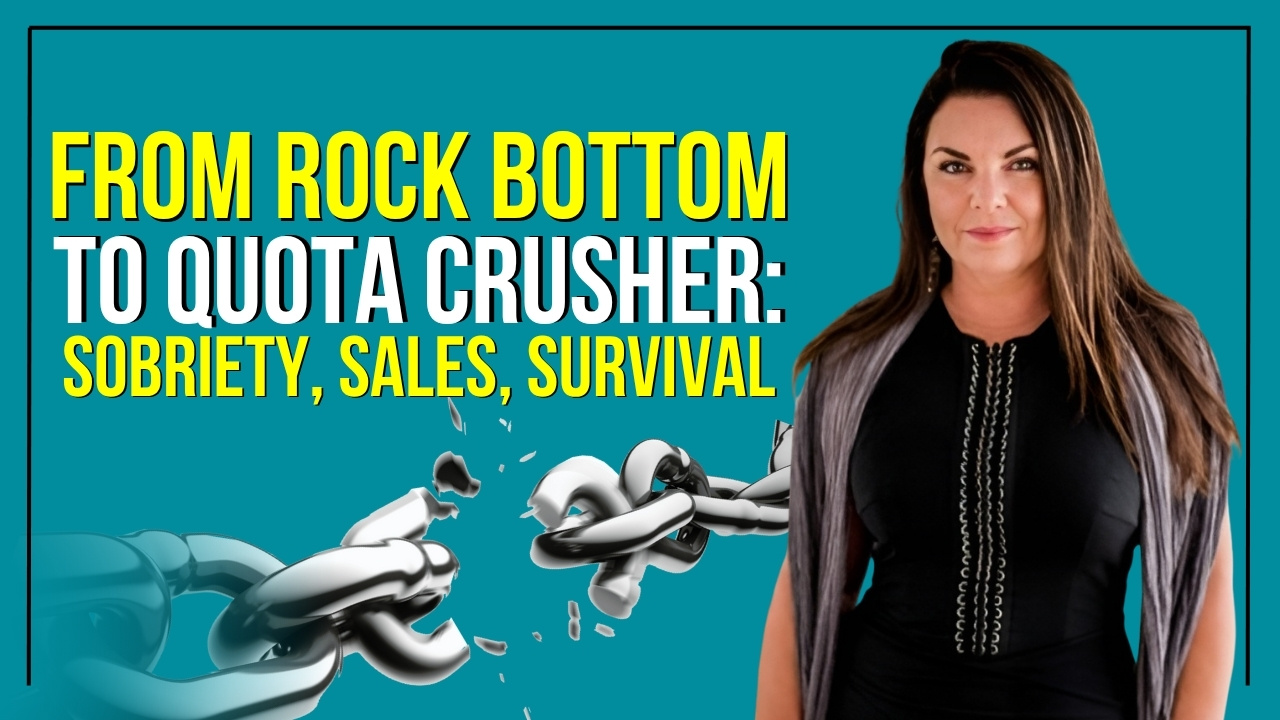
Sobriety does not only free you from your addictions – it can also level up your entrepreneurship approach. Tim Westbrook is joined by Narelle Gorman, a powerhouse business strategist and global speaker in long-term recovery. She explains how her recovery journey plays a huge role in building her purpose-driven brand and maintaining her integrity despite the many challenges along the way. Narelle also reflects on her humble beginnings and the traumatic experiences she went through that intensified her compassion, shaped her resilient mindset, and transformed her into a heart-led entrepreneur.
—
Watch the episode here
Listen to the podcast here
From Rock Bottom To Quota Crusher: Sobriety, Sales, Survival
Our guest is a powerhouse business strategist, heart-led entrepreneur, and global speaker who has spent over two decades turning vision into legacy. She’s also in long-term recovery. With two successful exits, a career that spans multimillion-dollar launches, she is a high-impact mastermind who has even had the honor of introducing the US President. Narelle has always played big, but her journey also includes a deep personal transformation, which makes her work and wisdom resonate at the soul level. In this episode, we’re going to talk about sobriety in business, survival, sales, service, and lessons learned from walking through the fire.
‐‐‐
Narelle, welcome to the show.
Thank you very much for having me.
Business Strategist, Speaker, And Entrepreneur Narelle Gorman
I’m grateful that you made it. What was your rock bottom?
First, I’m laughing about the intro because there is a little bit of AI in there. I’m like, “Is that me?” As I hear you read that, I’m like, “I’m just a girl from the bush.”
What do you mean you’re a girl from the bush?
I grew up out in the middle of nowhere in rural Australia, in a little town. In one of the towns I lived in, our biggest claim to fame was that we had the biggest wheat silo in the Southern hemisphere. We did not have a telephone until I was sixteen. We did not have running hot water. I’m from very humble beginnings.
Did you have siblings?
No.
You and your parents?
No. I lived with my grandparents. My mom went off to be a nurse. She lived in the city, and she would come home every now and again. I lived on the farm with my grandparents.
How was it growing up with your grandparents?
I smile about it because I love the fact that I grew up on a farm. I have fond memories of it, even the point of learning how to pluck chickens. We would have a big 40-gallon drum with a fire underneath it and water. My grandfather would be doing the chickens, and my Nana would be sticking the chicken in the hot water. We’d be plucking it. We used the feathers for pillows, and we used the chicken to eat.
What kind of a farm was it?
It was an everything farm.
It was a farm for you to live. It wasn’t necessarily for business. You didn’t sell anything.
We sold lots of things.
You sold whatever you could sell.
We sold canaries. We sold milk. We sold lots of things, but it wasn’t a farm that was set up for revenue generation or anything like that. It was about survival.
How big was the farm?
That one was not that big. We probably had about 50 acres there.
Chickens, and what other kinds of animals?
Geese, chickens, ducks, cows, horses, and dogs.
How many dogs?
We had three dogs. Our oldest dog’s name was Pearly. She lived until she was 23 years old.
When did you move to the US?
I didn’t actually move to the US. It happened. I ended up here. When I came here, it was only supposed to be for a three-month stint. It turned into a longer stint. I’ve been in the US on and off for 27 years. A long time.
What brought you here?
I had a partner at the time who had played rugby for Australia. He had a contract to coach. They’d asked him to come over here and coach rugby up in San Francisco. He said yes, and he asked me if I wanted to come with him. I was like, “That sounds like a great idea.” That was the beginning.
Your first place in the US was San Francisco?
Yes.
Where were you in the city?
I was living in an area of San Francisco, which is the East Bay. It’s called Alameda.
I know where it’s at. I lived in Walnut Creek. I lived in the Bay Area. I spent about ten years in Northern California. I went to Davis. I lived in Noe Valley, Russian Hill, and Walnut Creek, so I’m familiar with it.
I used to catch the BART from Fruitvale Station into the city. I worked above Montgomery BART.
How long were you in the Bay Area for?
On and off for about two years.
Falling Asleep In The Snow
Let’s talk about your rock bottom. Let’s go back to that. What was your rock bottom?
Which one?
I know we have lots of them.
I’m a deep-feeler, so I may get a little bit emotional when I talk about things. The one that pops into my mind was the time I was living in Aspen, Colorado. I was in one of the most beautiful places in the world. I call it Heaven on Earth up there. You’re at twelve-and-a-half thousand feet. There are snow caps on the mountain and everything.
I woke up in a hospital, and I had no idea why I was in the hospital. The last thing I remember is I’d been out and about in the town of Aspen, having fun. I woke up, and I had a green outfit on and a drip in my arm. The doctor had asked me if I had tried to take my life because they’d found me face down in the snow. They did not know how long I’d been asleep in the snow. He also told me that there was a possibility I might lose part of my nose and the tip of my finger due to frostbite. I still have my nose.
You still have your nose and your finger.
I remember the words he said to me. He goes, “Young lady, were you trying to take your life?” I said, “No.” He’s like, “They found you, and when they found you, they bought you here. You had a blood alcohol content of 0.39.” 0.40 is clinically dead or brain dead. I don’t know the stats on that because I’m not a doctor, but it was pretty tragic or up there, especially for somebody that’s 5’1” and 120 pounds. He said to me, “Do you think you have a problem with alcohol? You might need to go to an Alcoholics Anonymous meeting. Would you do that for me?” That was my rock bottom.
How long were you in the hospital at that time?
They brought me in at 9:00 or 10:00 at night. I don’t remember what time it was that they let me out.
If you’re 0.39, I would imagine that it would take a minute before they would release you.
I have no idea. It was a long time ago. I don’t know what time it was that they let me out. I don’t even know how I got from the hospital to where I was living. I could have gotten on a bus. I don’t remember it at all. Maybe a friend came and got me. I don’t remember.
Is that when you got sober for good?
Sadly, it’s not.
Did you try to get sober at that time?
I went to the AA meeting as he had asked. With the AA meeting, there’s a pretty cool story to that. The AA meeting was in a back street in Aspen, Colorado, in a beautiful church. It was a women’s AA meeting. I went in there, and I looked for the differences. As I look back at it, I looked for the differences. The women were talking about pills. They had fur coats on. They had diamond rings. They were fancy. I don’t remember if I did the whole meeting, but I know that I left and went to a bar that was across the road. It’s called Legends. I then proceeded to get completely shit-faced.
That sounds about right. How old were you?
At that time, I was 25.
Losing A Leather Coat In San Francisco
Give me a little bit of your journey, like some of the main points of your journey. When did you get sober?
I do have a sobriety date. My sobriety date is June 5th, 2000. The hospital visit would’ve been three years before that. One of the things that had preceded my sleeping in the snow was that back in those days, the internet wasn’t like it is. They had a thing called Interpol. Interpol came and knocked on the door where I was living. They asked if I was Narelle Gorman, and I said, “Yes.” They said, “We have a phone number for you. You need to call that phone number.”
When I called the phone number, I knew what it was going to be on the other end. I don’t know why, but I knew. That was when they told me that my father had taken his life. It was a pretty traumatic time. Also, after the inventory, I look back at it, and it gave me an excuse to drink the way I wanted to drink. If you had been through what I’d been through, you would drink like I did, too. Do you know when they say you crossed the line? That was when I crossed the line into full-blown alcoholism. I didn’t care. I had a hole in my soul that was very big, and it needed filling.

Long-Term Recovery: My father had taken his life. It was a pretty traumatic time, and it gave me an excuse to drink the way I wanted to drink.
What happened to where you got to the time you got sober?
I’m processing a little bit because it still hits home sometimes, the memory of it. The last time I took a drink was in San Francisco. How about that? I was working at the time in San Diego. I was working for a dental company and was doing extremely well. We had an event there in Sausalito, which is a very nice area. We had a bunch of dentists in town. I worked in the dental industry. I was in marketing and sales for the dental industry.
That makes sense.
I was teaching masterminds to dentists before masterminds became what everybody has one. We had this event. I knew during that event that I needed to behave myself, so to speak, so I didn’t have a drink for the entire week. At the end of the event, we had dinner, celebrations, and everything. That monkey on my back was getting itchy. I was like, “How do I get away from all these dentists and go and do what I want to do?”
I did the dinner and everything, and then I was like, “I’m going to go to Loose for Blues.” It was this bar down in San Francisco. I took myself down to Loose for Blues. I had this beautiful full-length coat that I had bought myself with a big fat commission check at the time. I was listening to great music and having a fun time.
I woke up the next day in the hotel room, and the leather coat was gone. I don’t recall getting back to the hotel room. I had missed the 7:00 AM flight that I was supposed to be on with my boss. I figured, “I must have left the leather coat at Loose for Blues. I’m going to go and get it, and then I’ll come back and figure out the flight and everything.”
I went into the bar and asked the guy if he’d seen my leather coat. He said no, but asked if I’d like a commiseration drink. I had a glass of Chardonnay and a shot of Jager. Some guy sitting there offered another shot of Jagermeister. I thought, “Why not?” That’s the last thing I remember until I have a snippet of memory of walking around the San Francisco airport, pretending I couldn’t speak English.
That makes sense.
I got on a plane. I didn’t have the ticket because I missed the 7:00 AM flight. Apparently, I decided that I’ve never gone back to the hotel room or gotten any of my things. I left everything there. I have no recollection of the flight. The next thing I know is I’m on the back of a golf buggy, telling the guy, “My car has got to be around here somewhere.” I was in San Diego at the airport, trying to find my car.
The car wasn’t there because I had parked it offsite. I remembered that I had parked it off-site and somehow got to the off-site parking lot. I asked the guy at the off-site parking lot, “Would you please call a locksmith?” I needed my car re-keyed because I had no luggage. I had no keys. I had nothing. Maybe I had my handbag. That was it. He thought that I had too much to drink and called the police. The police came. I didn’t know he had called the police. I was waiting for the locksmith. The police came, and I was sitting on the ground next to my car. What was that TV show? Was it How to be a Millionaire or something where you’ve got 1 call or 2 calls?
I don’t remember.
There was a TV show like that. He was like, “You can call a friend, or we can take you to jail, or we’ll take you to detox. We think you’re a danger to yourself right now.” I couldn’t call a friend. I had friends, but I didn’t have anybody to call. I removed myself from my family and everything. I didn’t want to go to jail, so I said, “Take me to the detox.” He took me to the detox. I sat on a blue mat. There were lots of homeless people, and it didn’t smell very kind and friendly in there. Remember, I’d come from a fancy dental event.
From a fancy hotel with all the dentists in Sausalito.
To a blue mat with a horrendous smell. I can still smell it. That was the last time I took a drink. I don’t want to get into a drunkologue, but it’s a pretty wild story.
I’m listening to your story, and I can relate. I lost a leather jacket in San Francisco. I remember I went and blacked out, but I lived there. I remember going back to all these places where I thought it might be. It was an expensive leather jacket, and it was gone. Leaving all your things in the hotel room and checking out without getting your stuff, I’ve never done that before, but it sounds like something that I would’ve done.
I’m glad I’m in good company.
Going Down The Path Of Recovery
You’re not the only one. I’m sure there’s stuff out there. That’s pretty good. You got sober. You did a detox. Did you go to treatment?
No.
AA?
That next morning. I left the detox when they said that if I blew in a bag or something and the crystals didn’t turn green, they’d let me out. That morning, I was like, “I got to get to work. I got to cover my ass,” because I had no one. You have to remember that I’m on the other side of the world. There was no one. There was no boyfriend, nothing like that. I was like, “I can’t lose my job.”
I managed to get to work on time. My boss was like, “Where are all the deals?” I made up some story and stuff. It was the next day that I went and I said to him, “I need to talk to you about something.” He said, “What do you need to talk to me about?” I went and I sat in front of him at his desk, and then I said, “I think I might be an alcoholic.” He looked at me and went, “No shit.” I went to lunch, and when I came back from lunch, there was a yellow sticky on my computer. It had a phone number.
When your boss said, “No shit,” was it as in like, “I know.”
Yeah. He knew.
It was a sarcastic, “No shit.”
When I came back from lunch, it had a phone number on it. He walked in and said, “That number is to Betty Ford. I’m an alumni. If you want to go, I will keep your job for you for 30 days.” This was back before they had all the rules and regulations. Inside of me, I knew I couldn’t go because I didn’t have anyone to pay the bills for other things. I couldn’t do it, so I took myself to AA. I started AA. That’s when my AA journey started. I white-knuckled it without the luxury of a detox facility, a recovery home, or anything. It was just determination.
What did your first year look like?
Extremely angry.
Besides being angry, what is your first year of recovery? What was the recovery process like for you?
I put my head down. I’ve always been a hard worker. It must come from growing up on the farm.

Long-Term Recovery: As someone who grew up on a farm, I have always been a hard worker.
I hear the people who work on farms work hard.
I put my head down, and I focused on work. I would go to work, get home from work, take all my makeup off, put on sweats or whatever, and put my hair in a ponytail. I had no driver’s license and no money. I would walk myself to an AA meeting. My mental idea behind that was that if I didn’t have any money, I didn’t have an ID, and I didn’t look good, I couldn’t stop in the bar and get anyone to buy me a drink.
That makes sense.
I would walk myself to an AA meeting and walk back. I was lucky that there were a lot of meetings around where I got sober. I would walk back to my apartment, take a bath, and then get in bed. I did this, praying that they told me to do. They told me to get on my knees and pray. I didn’t believe in anything at the time, but I followed the directions.
There are a lot of old-timers at meetings. If you’ve never been to a meeting, there are these old guys who sit in the corner and have been around for many years. They would tell me, “If you still want to drink, go out and drink.” I’ve always been a little bit obstinate, so I’d be like, “I’ll see you tomorrow.” I go back to prove them wrong.
It works.
That was a lot of alone time and a lot of hard work.
It’s like learning how to live life differently. I don’t know about you, but for me, my whole life revolved around alcohol. It was in everything I did. I would imagine that you were the same. You have to completely learn how to live life differently.
Your whole life rotated around it, so it was new friends and a new environment.
New hobbies. New interests. You walk to an AA meeting, walk home, take a bath, and pray in the morning.
I got a sponsor. There was this Monday night meeting. It was all old people. It was back in the day when roller blades were a thing. I had a pair of roller blades. I would rollerblade to that meeting. I’d fly into the meeting, do a 360 in the middle of the meeting, and then sit down. They’d tell me to take my roller blades off, and I wouldn’t take them off. I was a little bit of a rebel. I look back at it and I laugh, but at the time, I did what I had to do.
It was your journey.
I didn’t want to die.
How Sobriety Can Shape Your Entrepreneurship Approach
Switching gears, you’ve built multimillion-dollar businesses and advised transformational leaders. How has sobriety shaped your approach to entrepreneurship?
There’s a song that comes to mind. It goes, “I get knocked down. I get up again.” I don’t know who sings it. I’ll have to look it up.
I know what song you’re talking about. I’m not thinking of the band.
That would be the thing. Entrepreneurship is you’ve got to be ready to take the hits, and you’ve got to get back up again. It’s not an easy road.
Entrepreneurs have to be ready to take hits and get back up again. It is not an easy road. Share on XIt’s not a walk in the park.
I don’t believe it’s a walk in the park. There are some people out there who have had a walk in the park with it, but that wasn’t my journey.
It’s like sobriety is not a walk in the park. You get sober, and you think it’s all going to be rainbows and butterflies. That is not the case. When you get sober, there’s still stuff that you get to deal with. As an entrepreneur, it’s the same thing. A lot of times, people look at entrepreneurs and they think that they’re living the life because they’re making a ton of money and helping a lot of people. They don’t see the challenges that we have to go through, or whatever you want to say.
To get back up again, but also, integrity. It’s the steps on my side of the street.
Living the principles in all your affairs.
When I make a commitment, I follow through on the commitment. It could even be something as simple as this, coming in and doing a show with you, which is not a simple thing. This is a commitment that I made. This got put on my calendar. It doesn’t matter what else comes up. This is something that I gave you my word that I’ll be here. Therefore, I will.
I don’t know about you, but I’m sure I’m not the only one. I make a commitment, and I get closer, and it’s just on my calendar. I’m lazy sometimes. A lot of times, it sounds better to skip something. If it’s on my schedule, I’m going to do it. I was invited to an event. My plan was to have dinner and relax at home. I got invited to this thing, which was a good thing to be invited to. It could have been a good thing for me to go to. I’m not going to share what it is. I said, “I have plans.” I didn’t want to go. I didn’t want to get dressed up. I didn’t want to go be around a bunch of people. I had a long day. I was up early. If that was on my calendar, you can bet I would’ve been there.
As you say that, a lot of my friends will ask me to do things, and they’ll want me to plan ahead of time. I’m extremely spontaneous. They’re like, “That’s right. You don’t like making plans.” It’s not that I don’t like making plans. It’s that if I make a plan, it has to go through.
Protecting Your Personal Journey During Recovery
You know you’re going to follow through. You’re very protective of your time. We only have so much time in the day. What are the priorities? In the business world, anonymity around sobriety can be tricky. How have you navigated being open about recovery while protecting your personal journey?
When I got sober, it wasn’t a thing on TV. It wasn’t hip to be sober, so I protected my anonymity. I did not talk about my sobriety for at least ten years. I kept it very close to my heart. I did not want to let anybody know about it. I even remember being at an event with a bunch of dentists. I worked with cosmetic dentists who have amazing practices. I remember sitting next to one, and he asked me, “You’re Australian. Could you select the wine?” I said, “Sure,” and I picked a bottle of wine. The waiter came and poured the glass for me to taste it. I was like, “Let the man do it.” The waiter poured a glass for me, and it sat in front of me.
How much time had you had at that time?
At that time, I would say about eight years. The dentist who was sitting next to me said, “Aren’t you going to drink your glass of wine?” I said, “I will when I’m ready.” I was protective. I didn’t share with you that I had an obsession with drinking every single day for almost ten years. The obsession did not go away for me. When you talked about the pink clouds, the rainbows, and everything, I wasn’t one of those people.
At that time, you were still obsessing about drinking, and you had that glass of wine in front of you.
I’ll share a little bit more about that if I may.
Please do.
The CEO of the company is a great guy and a super awesome businessman. He loved to take all the dentists to the strip clubs. He loved to do extracurriculars. He is a super awesome business guy who loves to socialize. He had no idea that I didn’t participate in those things. There was no way I was going to let him because if he knew, it was like, “Who’s going to get promoted? The girl that can schmooze with these guys, or the girl that’s super straight and doesn’t do anything?” I kept it close to my sleeve.
That particular night, I managed to get away from the glass of wine. I then went to the bar where we were all socializing. The CEO accidentally spilled a tangerine martini on my arm. The reason I know it was a tangerine martini is because I could smell it, and I’d seen it on the menu. I was angry that I couldn’t have one. When he split it on my arm, tears came to me because I wanted to drink one so badly. I wanted to lick it off my arm.
At that time, I was like, “I need to remove myself from this situation.” I remember going up to the hotel room and locking the door. I had the minibar taken out. I always got the minibar taken away. I sat on the bed and cried. I called my sponsor, and I cried because I wasn’t normal like others. You ask about anonymity. It was like I was not free with my sobriety at that period of time.
It was not as acceptable then as it is now. I got sober in 2011. I was pretty open. I didn’t share it with everybody, though. I shared it with a lot of people, and then I got into this business. I started Camelback Recovery in 2014. Obviously, I’m sharing it with everybody. What I noticed now is I can’t go anywhere without seeing people who are in recovery.
I love it.
People are in recovery everywhere.
There are people in recovery in movies and TV shows. That Shameless TV show comes to mind.
Whether it’s Iron Man, hiking the Grand Canyon, doing yoga, going to yoga teacher training, or whatever it is that I do, it seems like about 30% of the people are in recovery. The other thing that I’ve noticed, too, is that more people are not drinking, not because they’re alcoholics. When I first got sober, if you didn’t drink, people were like, “Are you an alcoholic?” There are a lot of people who don’t drink, because it’s not good for you.
Even on the dating apps, they have a category that says Sober Curious. I’m like, “What are they curious about?”
How Sobriety Gives Entrepreneurs A Competitive Edge
It’s good stuff. Do you believe sobriety gives entrepreneurs a competitive edge of more clarity, focus, and alignment?
I’m biased, so I’m going to say absofuckinglutely. The ability to follow through on commitments. The ability to be clear. The ability to be focused. The ability to have the principles of the program. They’re foundational. All of these EST, Landmark, and training that you go to around the world, people have paid $10,000 to sit in the room, and they’re like, “Go and make a phone call. Make amends to those people that you haven’t talked to for ten years. Get your family to come and support you.” I’m like, “That’s the ninth step.”
The integrity is huge. The clarity is huge. I love that I get to wake up every morning with a clear mind. It may be monkey chatter. There may be a lot going on, like, “What deal am I going to close? Is that enough money? Did I put the clause in there? Did I forget it?” There are those things that go through your mind, but the clarity of knowing.
You’re not hungover. You’re not going to get a DUI. You feel good about your decisions. You remember what you did last night.
I didn’t kick that employee because I was hungover and grumpy. I didn’t take out that irritable, restless, and discontent thing.
I remember before I got sober, I knew a lot of people who were drinking that were successful, so I thought that successful people drank a lot and partied. That was my justification for drinking and doing drugs. That’s not the case. It’s not true.
I think of the movie The Wolf of Wall Street.
That’s the perfect example of people who are crushing it, although they’re empty and unhappy. What I wanted was to make a bunch of money at that time. Now that I’m sober, I’m like, “I want to make enough money to live a good life.” Doing the next right thing, being of service, and making a contribution to this world is way more important than anything else because I want to feel good.
One of the things that comes with sobriety is a conscience.
Not All Money Is Good Money
We had a conscience before, but we would drink because we felt so guilty about our actions. For me, it’s the guilt and the shame of lying, cheating, and stealing. When you lie, cheat, and steal, you need the solution. What’s the solution? More drink, more drugs, more sex, and more of that stuff to numb out. Let’s talk about acts of service and soul-aligned strategy. You describe yourself as helping businesses scale with integrity. What role do genuine acts of service play in scaling a purpose-driven brand?
One of the things that I drive is the sales side. Without sales, you can’t scale. Without a strategy, you can’t scale. One of my mottos is, “Not all money is good money.” For example, sometimes, I’ll bring in a done-for-you sales team that may be at an event that has 3,000 or 4,000 people at the event. We’ve got a revenue goal, and we don’t get to go to sleep until that revenue goal happens.
Not all money is good money. Share on XOne of the things that I’ll always say to everybody on my team when I do sales training is, “We do not take money from people that it’s not good to take it from.” What I mean by that is if you are sitting in front of somebody and you, in integrity, do not believe that this person is going to be successful with the services that you have to offer, don’t take the $20,000 or the $30,000. Redirect them to something that is more suitable.
The integrity, ethics, and morals do not cross them to make a sale. The money will come. I would much rather that we be able to be integrity-focused. To me, sales is about educating people in making powerful decisions that are going to empower them, not powerful decisions that are going to align my pocket. I’ve always said, “Never ever think about the commission or the percentage that you’re going to get. Think about the person that’s in front of you.”
How do they make that determination?
The person who’s in front of you or the coach?
It is you, as the person who’s trying to close a deal. I’m thinking to myself, “How do I know that this person isn’t a good fit?”
It’s intuition. It’s a feeling. We know what’s right and what’s wrong. We get that curly feel in front of us. They know if it’s a powerful yes or a powerful no. There is no maybe. Maybe is no. It is asking the questions, like, ‘What is it that you need to think about? Tell me more about that. Help me help you. Let’s walk through that to get you to a decision that you feel good about.
Your knees might be knocking. Your teeth might be chattering. You might hand over your credit card and we might charge $50,000 to it, but if you’re excited and it’s going to take you to where you want to go, then invest the money.” I believe if you are a true person who has sales inside of you, you know if you’re doing the right thing or not.
Balancing High-Stakes Strategy With Heart-Led Leadership
Good enough. How do you balance high-stakes strategy with heart-led leadership?
Same way. I believe that we have two brains. One is in our head, and the other is our gut. I believe that gut intuition is our second brain, telling us the right or wrong thing to do. If it feels icky, it probably is icky and probably not the right thing to do.
Gut intuition is our second brain that tells us the right or wrong thing to do. If something feels icky, it is probably not the right thing to do. Share on XCan you share a moment where service to others became the defining factor in a business breakthrough?
Nothing pops to mind on that one.
Unlocking Compassion Amid A Personal Challenge
Let’s talk about survival and transformation. You faced your own deep transformations. What’s one survival story that completely shifted the way that you live and lead?
I get quiet on that because I’m one of those people who, whatever comes to me or whatever hits me, is what I feel called to share. My son went through an extreme medical emergency at the beginning of 2025, and I honestly did not know if he was going to live or die. I’ve headed into that with 24 years of sobriety, and I found myself questioning, “If you take him, God, I don’t know if I will survive. I don’t know if I will have the will to live.” It put a lot of compassion in me for people that I did not have before. It also brought out a lot of humanness. I’ve always thought that I had that heart for people and their families. It has intensified it more. If you’re familiar with behavioral profiling, there’s one called DISC.
I’m familiar with it.
I’ve been a certified trainer in DISC for twenty-something years. My DISC was D off the page. I took it again, and the D has dropped. We adapt to our working conditions, but my natural D has dropped. My I has increased, and I have S now. S is a caring factor. I didn’t have that before.
S is Steadiness, right?
Yeah. C is Compliant Conscientiousness. I still don’t have C.
I haven’t taken it in a long time. I’m a high D, high I, low S, and low C.
You’re a people person. You’re charismatic. You’re charming. You’re probably in sales.
Probably. That’s a good guess.
It was interesting that I had that. I had a conversation with my son about it. I was like, “Your mom has softened out.”
They say that your Kolbe profile doesn’t change, but you think your DISC profile can change.
As a trainer, I’ve been told it doesn’t change.
Your MO.
It has changed. It’s got more compassion.
Why Entrepreneurs Need A Safe Container
That makes sense, though. Many entrepreneurs carry hidden struggles. What do you say to leaders who feel like they’re white-knuckling survival personally or professionally?
“Take your mask off. Find a group of confidants that you can be real, open, and honest with because the truth will set you free. Otherwise, it’ll take you to your grave.” How many entrepreneurs, big businessmen, and people do we know who are super successful when it comes to a spreadsheet or something, and yet they’ve taken their lives?
I think of Kate Spade, Anthony Bourdain, and Robin Williams. I think of all these people. Did they have the confidants to speak to? I truly believe that in entrepreneurship, we need a safe container. We need a group of entrepreneurs who understand what it’s like to own, carry a business, carry a profit loss sheet, and carry a payroll for hundreds of employees. Be real with that trusted circle.
We’re in the Genius Network together. That’s where we met. Genius Network has been that safe place for me. I’ve been a member since 2018. I’ve gone through some things. For me, it was going to that group, open up, and share what’s going on for me, and cry. Crying is the vulnerability and authenticity that I’ve learned, quite honestly, through AA and then being in Genius Network.
I still have all of the recovery community that I can share with, along with my sponsor. I’ve got friends in recovery. I also have people who are in Genius Network that I can open up and share with. They’re also running businesses, and they’re also having the same problems that I’m having. Some are worse than the problems I’m having. Whatever I’m going through, I’m not unique. I’m not the only one. There are lots of people who are going through exactly what I’m going through in one way or another.
I don’t mean to emotionally streak through the grocery store and say, “I can’t make payroll,” but talk to somebody.
Why You Need To Blame Yourself Less
You’ve got to have some people you can talk to. Let’s talk about radical responsibility and reflection. In recovery, we often ask, “What part did I play in it?” How has this principle shaped the way you handle setbacks or conflicts in business?
I am going to go out on a limb here and share a little bit of a twist on that one. I found that I took it to the extreme, but what part did I play in it? I took it to the extreme where I found myself taking responsibility for their behavior, my behavior, the whole thing, and the whole situation. I was like, “If I hadn’t done this, this wouldn’t have happened.” It set me back. I had a business situation where the person was very out of integrity. Yet, I kept looking at my side of the street, not their side of the street. I didn’t call them out on it because I had this thing in my head.
You were like, “What was my part?”
Their behavior is not up to me. Only my behavior is up to me. I don’t know if I’m making sense here, but it had a bad effect where I lost my boundaries. I went to the other side of the street. I became so soft. I was like, “I’m at fault.” I had to stop and say, “You are at fault. However, if their behavior isn’t in alignment, then you need to speak up about it.”
That’s a good point. Especially being early on in recovery, I was the guy who took all the suggestions. When going through the steps, it’s like, “What’s my part?” It doesn’t matter that they had a part that doesn’t matter. If I want true freedom and happiness, I’ve got to let that go. It doesn’t matter. It was like, “What was my part? What can I do to make it right? How can I make it right?” as opposed to, “You also owe me amends.”
If I’m thinking that this other person owes me amends and I’m expecting amends, then I’m never going to be happy. There was some stuff that I went through where I made amends. Ten years later, I’ve got some stuff with my family. It was like, “Wait a second here. I wasn’t the only one here. Everybody has a part, too.” I was like, “Here we are, ten years later. I wasn’t the only one. We all played a part.”
It’s almost like if I leave the car in the driveway and I leave the keys in the bowl on the kitchen table, and the Airbnb person takes my car and crashes it, what part did I play in it? I left the keys on the table, and they took the keys. There has to be a boundary there. I wasn’t fully responsible for that car getting crashed. When I was on that side of the street, I would’ve been like, “Had I not left the keys there, that would never have happened.”
What’s the path to freedom? Freedom is like, “What’s my part?” Also, to your point, there are boundaries, and not letting people walk all over me. It’s all recovery. Recovery is a journey. It’s not a straight path. Learning boundaries, building relationships, making amends, and all those things are part of it, in my opinion.
There’s a lot. I love that it’s progress, not perfection. I know damn well I’m not perfect. I don’t ever think I will be perfect, but as long as I’m looking to make progress. If I regress, then I look to progress as well.

Long-Term Recovery: Sobriety is all about progress, not perfection.
Two steps forward, one step back. Can you share a time when taking ownership, even for something uncomfortable, opened the door to growth or resolution?
I’m sure there are 100 of them, but nothing pops into my head. I wish I could give you one, but nothing’s popping in.
Unlocking Freedom And Maintaining Integrity
You’ve turned vision into legacy multiple times. What’s your vision?
My true vision is freedom. My two values are freedom and integrity. My true vision is freedom and to bring freedom to others. I had a conversation with Sam Horn, who was also part of Genius before. She’s an amazing speaker and has written some good books. She called me out because I’ve been the name behind so many New York Times bestsellers and so many big transformational coaches, events, and things.
She was like, “Maybe it’s time for you to come out and write your book.” My vision is to be able to share my story so that others can benefit from it and step out from behind the black curtain, so to speak, which is scary. It’s easy when you promote everybody else, not yourself. That’s because then if they fall, they’re the ones falling, not you.
It’s much less risky.
What if I write a book and nothing happens with it? I’ve failed myself. What if I write a book and it goes worldwide because of the things that I’ve overcome? There are many that we didn’t even touch on. Somebody gets freedom.
Most importantly, you get freedom by sharing your story.
As hokey as it sounds, it would fulfill me more to know that from sharing my story, another beautiful, intelligent woman who perhaps has lost themselves in the pursuit of filling that void or filling that hole regains her freedom.
How many women need to have that transformation for it to be worth it?
Ten.
What about one?
I’d like ten.
You like ten, but what if you change 1 life or you help 1 person?
I know I have already helped. I’ve already hit the one.
Every time I share my story at a meeting or on this show, we don’t need 100,000 or 1 million people to tune in. If one person hears something that’s going to help them, then that’s it.
I released an employee once because she had a drug and alcohol problem, and it was very evident. At the time, she was in tears over it. She was upset. It’s not a nice thing to get released from your job. Fast forward a few years, and there’s that inbox of messages in your Facebook. They’re random. I opened it, and there was this message.
She didn’t use the word release. She used fired, but I like released instead of fired. She said, “Narelle, because you fired me, I’ve now been sober for five years. It’s because of you that I have a son. It’s because of you that I work for Virgin. It’s because of you that I met Richard Branson.” Reading that brought tears to my eyes. Karen, if you’re reading this, thank you for writing that message.
Listening To The Gut, Your Second Brain
It makes it all worth it. That’s amazing. For someone reading who is fresh in sobriety or early in entrepreneurship, what’s one powerful action they can take to align their strategy with soul?
Listen to that second brain, your gut, and then take the step.
Not to be confused with the devil on your shoulder.
It’s that gut feel. It’s also doing that one thing that looks like such a big mountain. It may be the introduction. It may be reaching out. It may be writing that one email. Let’s do one little thing at a time. Rome wasn’t built in a day. Do one little thing at a time, and you’ll get so much closer to it.
One step at a time. One day at a time. One hour at a time.
One breath at a time.
Next right thing. Is there anything I missed or anything I should have asked you?
No. There is nothing that comes to mind.
Get In Touch With Narelle
How can people learn more about you? Do you want to talk about your service and your offerings? How can people find you or learn more about your program?
They can find me on Instagram. I’m not somebody who promotes myself. I have worked strictly by word of mouth behind the scenes. I’ve not marketed myself for years. I believe that if you do what you do and do it well, others will follow. One of the first companies that I was with was called Dental Referral Service. Word of mouth travels.
If you do what you do, and you do it well, others will follow. Share on XIt does.
I do have an Instagram. The Instagram is @ResultsYouWant_. They can reach me on Instagram, but don’t expect any big hoo-ha or anything because I have been behind the scenes.
Who’s your ideal client? If someone were interested in working with you to help them build and scale their business, who would that be? I know you’re not here to promote yourself, but I’m asking you the question. I want to throw it out there. If there’s somebody who has resonated with anything that you’ve said, I want them to be able to know what it is that you offer.
My ideal client would be somebody who is the talent. They’re speaking on stages. They’ve written the book. I’ve worked with multiple New York Times bestsellers. They have a team. They keep training the team. They keep holding a lot of the hats. They want somebody who’s going to come in, strategize with them, be an extension of them, and help increase revenue while doing it with integrity and dignity.
That’s all we got. Thank you so much for sharing your wisdom, your journey, and your sobriety. I enjoyed getting to know more about you. Thank you for your time.
Thank you for inviting me. That’s one thing that I’ve been taught. When the hand gets out, always say yes. Thank you for allowing me to put a yes and to share my experience, wisdom, and strength. Also, thank you for what you’ve done here. It’s amazing. Talk about Camelback Recovery. He’s got this insane location. It’s beautiful. The moment I walked in, I felt my shoulders go down. I got off a plane, and I got to relax and feel great. Kudos to you for building this, for all the lives that you’re saving, and for all the lives that are being saved because of the lives that you’re saving. When we get into sobriety and carry the message, it’s a ricochet effect. Are we in Arizona?
We’re in Arizona.
We’re in Arizona, but what you are doing is affecting people in New York, Australia, Hong Kong, and Estonia. It’s going everywhere. Kudos to you.
I appreciate that. Thank you so much.
Thank you.
That’s all the time we have. Thanks for tuning in. We will see you in the next episode.
Important Links
About Narelle Gorman
 Narelle Gorman is a powerhouse business strategist, heart-led entrepreneur, and global speaker who’s spent over two decades turning vision into legacy. A female founder – who has had 2 successful exits from companies she started from scratch, built her first home at 18, has more stamps in her passport than a post box, and even had the honor of introducing the U.S. President, Narelle has always played big — but not without walking through her own deep transformations.
She’s the behind-the-scenes architect for multi-million dollar launches, high-impact masterminds, and purpose-driven brands that serve from the soul. As a certified Mindvalley business coach and trusted advisor to transformational leaders, she helps businesses scale with integrity — aligning strategy with soul and results with real impact.